Platero y yo

Here is a little about this famous Spanish book from this page. Below is a powerful video of one of the poems.

This is a literary text written in poetical prose. It is also part fiction and part autobiographical. It relates the life of the author in his beloved hometown, Moguer, Spain. In addition to the relationship that he has with his faithful little donkey, Platero, the story depicts the life in a small Spanish town, of the author’s life after he returned to his hometown after being gone for a while. The towns’ people see him as being a odd….dressed in black, and always accompanied by his donkey…the town’s children call him “El loco”.  The book is divided into 138 short sections, narratives, which are numbered chapters; no one contains more than eight paragraphs. It is poetical in the author’s choice of words and style of writing: metaphors, similes, symbolization, and lyrical impressions abound. Keeping with the poetical prose of Romanticism, the author utilizes musical aspects of language as well as poetical images. Many think JRJ wrote this book with children as his intended audience; however, the author himself addressed this in the prologue to a later edition saying that this was for no one.
“Some people believe that I wrote Platero and I for children, that this is a book for children.

No. In 1913, the editor of La Lectura, who knew I was writing this book, asked me to advance 

a few of its most idyllic pages for its “youth series.” Then, changing my idea momentarily, 

I wrote this prologue:

A NOTE TO THOSE GROWNUPS WHO MIGHT READ THIS BOOK TO CHILDREN:

This short book, where joy and sadness are twins, like the ears of Platero, was written for… I have no idea for whom! 

… For whomever lyric poets write… Now that it goes to the children, I do not add nor remove a single comma. That’s it!

“Wherever there are children”- Novalis used to say- “there is a Golden Age.” Well. it is within this Golden Age, which is like 

a spiritual island fallen from the skies, that the heart of the poet walks, and it finds itself there so at home that its 

most cherished wish would be not to have to ever abandon it.

Island of grace, of freshness and of joy, Golden Age of children; I always could find you in my life, a sea of mourning; 

let your breeze lend me its lyre high and sometimes senseless like the trill of the lark in the white sun of the morning!

I have never written nor will ever write anything for children, because I believe that the child can read the books that 

grownups read, with some few exceptions, that come to everyone’s mind. There are of course exceptions too for men and for women.”  

Juan Ramón Jiménez

Debut

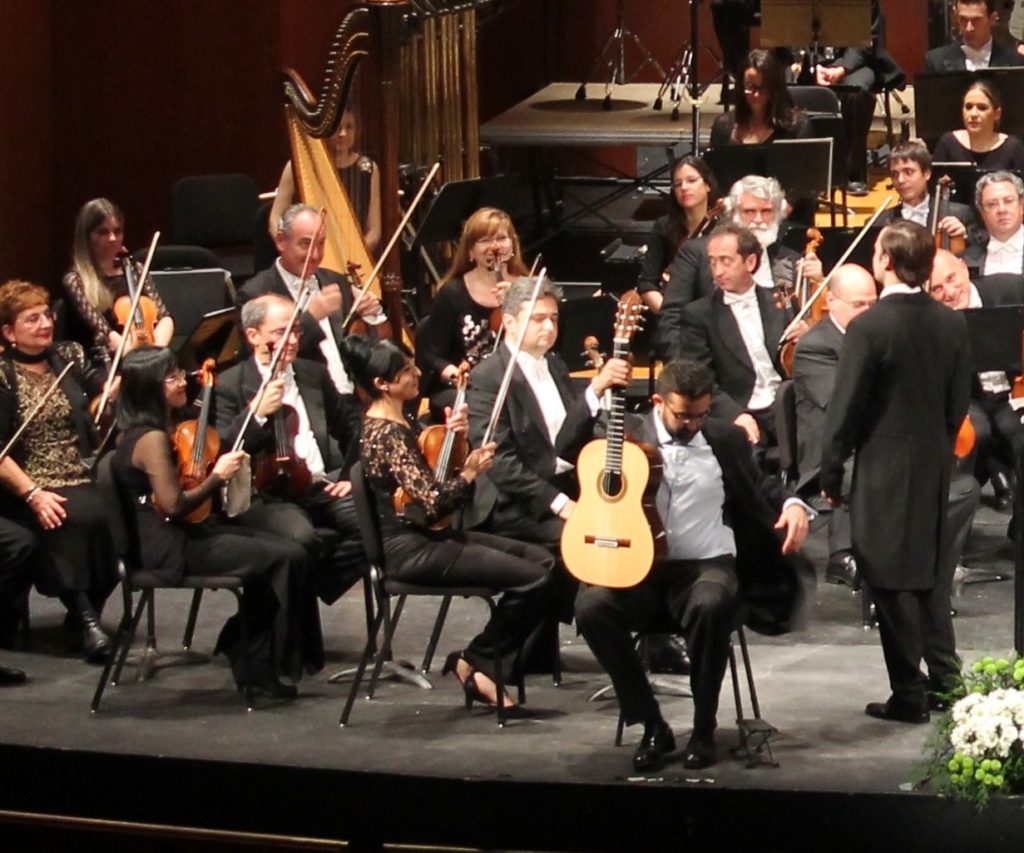
Hearing a guitar for the first time in the hands of a great player is a wonderful thing for a guitar-maker but if we are lucky enough to follow the evolution of the instrument and the player there might well be other milestones.  The first time on stage is a thrill too.  This was taken at the international debut of Lorenzo Palomo’s symphony “Córdoba” and the guitar is spruce and indian rosewood as perhaps is obvious.  The guitar was played without amplification and did just fine so “who needs a double top or lattice bracing?”  debut

Granada, la Camelot della chitarra


The prologue of the book “The Granada School of Guitar-makers” was written by Angelo Gilardino. As a matter of fact, having this excellent piece was very helpful in my search to find a publisher very early in the project. In the book you will find English and Spanish versions but of course he wrote it in his native Italian and the true beauty of his writing comes through better in the Italian. I suspect that is why he recently published it on his own page. If your Italian is good enough please read it here.

The Best Wood

I have already ranted about wood on a couple of occasions but this week I was preparing cedar and I feel like there is a bit more to say on the subject.  My objective today will be to get all of you to stop using the the term “master grade” when talking about wood.  Here are some photos showing things to avoid in the woods we use for guitar-making.  Woods sold as master grade can often show these defects once they are planed or cut.  The best wood is that which, in the hands of a given maker, makes for the best guitar.  The only person who can choose the wood is the maker.

IMG_5362The first example shows a cedar neck which is lightweight and perfectly cut but has a pithy or stringy part which is very hard to sand and finish nicely (bad wood). Also I don’t trust it to be stiff.  Below is a fretboard which has a kind of ripple or flame which will make it very difficult to plane, once glued to the guitar before the frets are installed.  This is a very important step for allowing adjustment of the action and it is not a good time for tear-out.  IMG_5364The next picture shows some beautiful cedar but as the cut was started the tensions in the wood caused it to close on itself.  Not only is this dangerous on the table saw but you certainly don’t want to use this wood for a neck or a bar as it will likely deform with time.  IMG_5365Once cut, the stick will look like the photo which follows.

IMG_5369

When cutting wood for bars or necks the cedar should be split to ensure maximum strength and stability.  Below is an example.  IMG_5372One thing you seldom run into when splitting cedar is a break like the one shown below, you sometimes get a hint from a dark line which shows where it will break.  Some say these are fractures caused by felling the tree; I really don’t know, but I can tell you that I always avoid using the piece if I see evidence of this.IMG_5371

The rosewoods too have their secrets, what some see as interesting or pretty grain others see as a tendency to deform or crack when we work with it. Flatsawn wood from very small trees, stump wood and severe run-out can all cause problems.  IMG_5373Ebony is the most prone to shrinkage of all the woods we use, a good reason to let it age as long as possible before using it on a guitar. Here is an ebony board which will be thrown out  because of deformation.  At some point before 1999 when I bought it it was sanded flat on both sides but as you can see from the picture tIMG_5375he surface has lost any semblance of flatness.

The last wood I will mention is spruce as I think it is the one that gets the most attention from the “master grade” folks.  When spruce is cut it is not cost-effective to throw away the pieces that have run-out or are not riftsawn.  Quartersawing produces a few excellent pieces but as more cuts are taken the pieces are progressively more skewed with respect to the radius of the tree.   Splitting a tree that is twisted (European spruce very often is) doesn’t work very well for the woodseller either so run-out is very often present.  I think it goes without saying that dealers do not test for stiffness so basically the things we as builders value are not taken into account when wood is graded.  Master grade is assigned according to colour, grains per inch instead of the criteria that we use.  Below is a top that has a knot which was cut out but shows the shadow which also must be avoided.  IMG_5376

Once again, please trust your guitar-maker.  If you feel you must ask him to use the best possible woods don’t ask him to use someone else’s criteria to choose the wood.  He knows what works for him and he knows more about wood for guitars than you and the wood sellers will ever learn.

Bandurria restoration

As I have mentioned before, bandurrias used to be as commonly made in Granada as guitars so makers had to be very familiar with them.  These days none of the good guitar-makers build them any more and you don’t see them taking repairs either.  A friend of mine inherited a bandurria from his grandfather and since it was made in a relatively well-known valencian factory in 1924 I agreed to restore it. IMG_5321Both the back and top had some minor cracks and the back had shrunk so much that it no longer rested on the reinforcements.  The choices for solving this last problem are reducing the perimeter of the sides or increasing the surface area of the back.IMG_5326  The bridge was coming off and when I took it off completely I saw that it had torn off once before taking a goodly amount of top wood with it and then been glued haphazardly back on.  Of course the frets were sticking out and felt like the neck was wrapped with barbed wire and the last of the problems rendering this instrument unplayable were the 12 IMG_5322wooden pegs! which were badly adjusted and cracked.   A challenge to be sure but I asked one of the makers here (José López Bellido) for some ideas and the specifications that a bandurria should stick to and it looks like it will be a musical instrument once again in short order.