If any of you are looking for a guitar and feeling flush then this is the instrument for you. It seems that it surfaced quite recently and is in relatively good shape it seems. See the auction here.
The video below shows an earlier Torres.

If any of you are looking for a guitar and feeling flush then this is the instrument for you. It seems that it surfaced quite recently and is in relatively good shape it seems. See the auction here.
The video below shows an earlier Torres.
Guitar-makers and makers of other instruments are not often in the news and when they are it is often due to the rare talent that one or two have for backroom politicking more than a testament to their professionalism. Not the case however with Antonio. November 3rd will see a deserving guitar-maker receive a medal from the Provincial government. Other recipients include a university professor and a poet. The ceremony will be held at the Manuel de Falla auditorium and with a little luck it will be an excuse for the guitar-makers of Granada to get out of their workshops. After all, I am sure that we all feel honoured by the recognition of our craft. Newspaper article in Spanish
I can’t find a video of Antonio anywhere so here is one of one of his guitars along with other guitars being played.
I am happy to report that Strings by Mail has ordered a new shipment of “The Granada School of Guitar-makers”. The books were sent off on Friday and so should be there early in the week. The book has been selling quite well and the reviews have been good. Strings by Mail has put it up on Amazon too so those who seem to think that Amazon is the only place to find books will be able to find it. Other points of sale are Los Angeles Classical Guitar and Dusty Strings in Seattle. Remember that one of the contributors has a little gift for everyone who buys a copy of the book. https://johnguitar.com/easter-egg/
Hi all, especially those of you in Spain. This Sunday (October 19th) is the First (I won’t say annual) Guitar-makers Swap meet in Granada. Bring things that you no longer use but are in good condition and would be useful to another guitar- maker. That might even include wood that you might be willing to trade for something else or even things you want to sell. For my part I have tools, jigs and some machinery from the workshop of Rolf Eichinger; things that just came out of storage. Feel free to call me to find out if there is anything of interest to you before you come although I am hoping that others will bring lots of stuff that will pleasantly surprise you. tel: 958-225481
El día 19 de octubre tendrá lugar en Granada el Primer Trueque Guitarrero. Es común entre los guitarreros en EE-UU y cada uno trae cosas del taller que no necesita (pero que sean útiles) y que espera cambiar por algo que sí le parece que puede aprovechar. Por mi parte tengo formones, limas, cepillos, algo de maquiinaria además de útilies fabricados para tareas de construcción. Todo esto del taller de Rolf Eichinger, cosas que han estado guardados hasta ahora. El horario será de 12h al 14h y de 17h al 19h. Mi taller está en la calle Solares 50 y el número es el 958-225481. El parking de la calle Molinos queda muy cerca.
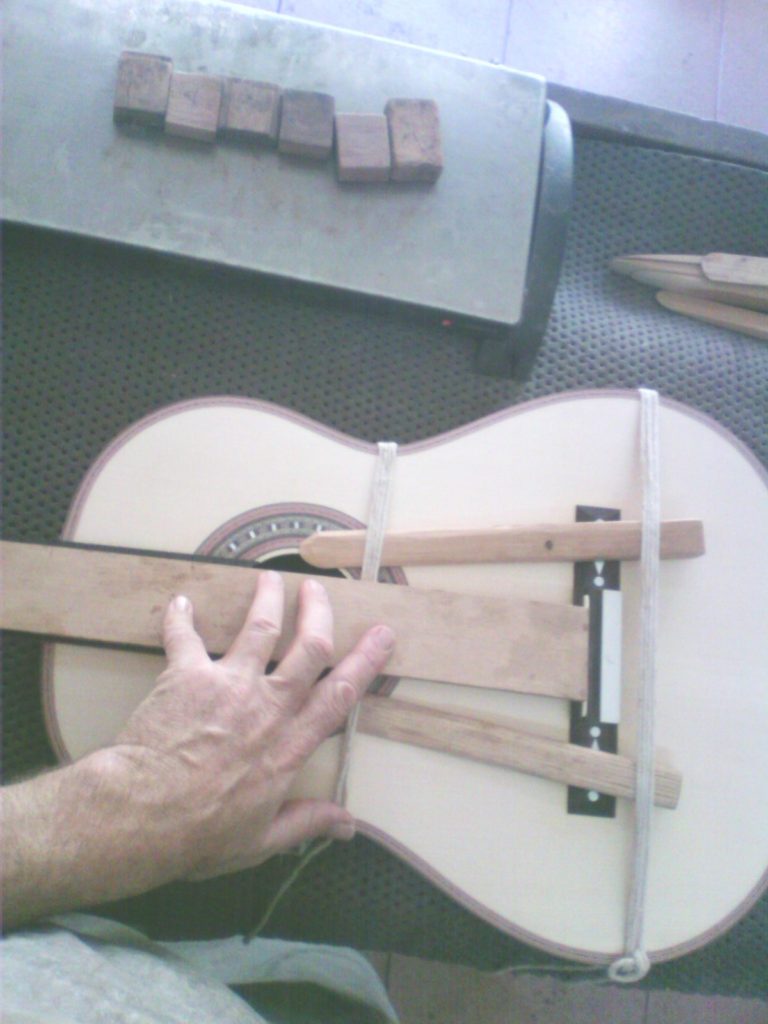
A mention of someone who had problems glueing a bridge on made it seem like it might be useful to explain this method. In addition to making perfect glueing surfaces which come together with the pressure which will be applied and knowing how to use hide glue, I think a simple method to guarantee bridge position is important. If your method allows you to use the saddle as a reference point it is much more precise than using the front edge of the bridge; you might change something on a single bridge and not take it into a account when you are sticking it on. The picture below shows a spacer which is exactly the length of the vibrating string. The wedges apply pressure to the bridge and push it up against that spacer and make it hard to go wrong in that axis. As for the other axis the tight-fitting saddle has a mark on it so that the position of the spacer (also marked) can be easily verified as you position the bridge. The spacer has exactly the same shape as the string layout so as long as the spacer is positioned with its edges along the desired run of strings 1 and 6 your bridge will be perfectly placed. The spacer is made to include compensation and even the bridge slant which causes the 1st string to be slightly shorter. It butts up against the nut and so be sure you know the vibrating length of the string with the most forward nut compensation. The pressure provided by the wedges shown is plenty for the task. There is nothing inside the guitar because the pressure only slightly flattens the dome allowing it to conform perfectly to the bridge. Sorry about the quality of the photo.