
These days, importing guitars into the U.S. is expensive and complicated. Shipping, insurance and customs charges can really add up and the “guilty until proven innocent” slant of the Lacey Act makes importation a real challenge for someone who has found a maker in Spain to make their dream guitar. Having someone in the U.S. who has a good realationship with the guitar-playing community and is trustworthy and deals fairly with customers and suppliers is a must for me now. On the west coast the dealer I consistently hear good things about is John Silva at Trilogy guitars. I spoke to John about a year ago but only just recently finished the guitar that he ordered. I am looking forward to a long a fruitful relationship with him.
Author Archives: johnray
Andrés Segovia Competition
I feel guilty today. I now realize that my readers are relying on me to report on the Andrés Segovia Competition (facebook) again this year. There are tons of seaches about it leading to my blog. Well I am sorry to say that I did not make the trip down this year. I hope it is not a sign of the times for guitarists and guitar-makers but only three guitarists actually participated. To top it off only two of them made it to the finals. Marco Victora Wagner from Brazil took first prize and Angélica Rodríguez from Paraguay won the Leo Brouwer prize and the Juventudes Musicales prize. Here is a newspaper article in Spanish. 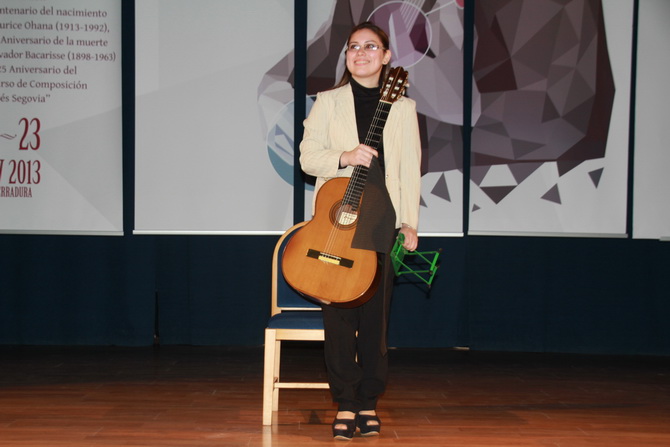
Getting my feet wet with Facebook
This is just a test to see if I can use Facebook to reach more people without having to learn how to use it and waste time doing things their way. This post should appear magically on my Facebook John Ray Guitars page without me having a personal profile on Facebook.
Update: it seems to be working so I will publish my old posts onto Facebook for those new readers I might get over there.
Artesania
A friend just finished a stint working for a local ice cream parlour and was telling us the other night about how they work. Just a few examples: The almonds they use are hand-sorted to ensure quality. The local strawberries are sourced from a single farmer. (Most of the strawberries in Spain are tasteless monsters often produced in greenhouses near Portugal.) This year they didn’t make their very popular blackberry ice cream because they couldn’t get enough of the fresh berries; frozen is not good enough for them. I myself have asked for orange sherbet and found on one occasion that it was not orange season so they didn’t have it and on another it was the beginning of the season and the oranges were still a bit tart. When I tasted it I was surprised to that this characteristic showed up in the delicious final product. This friend was very impressed with other aspects of how the business was run.
The spanish word “artesania” is much used and much abused but in its origin it referred to the traditional workshops where a trained professional produced functional articles that by their nature were unique and creatively made. These workshops were often associated and regulated through guilds. Ceramics, carvings, ornate furniture, leather goods, wrought iron, goldsmiths, blown glass, marquetry and instrument-making are just a few examples. These artisans persisted because there was a need for the product, the quality was very high and of course cheap industrial processes did not exist. In different historic periods there have been resurgences of artisanry for reasons of increased wealth and patronage by the nobility. Those examples that have survived into today’s industrial world have done so usually because of the quality of the work and the demanding clientele who are not satisfied with what industrial production has to offer. In order to make a living at such a time-intensive occupation the artisan must be well-organized, efficient and must be able to charge much higher prices for his products than the same product produced in an industrial setting.
My favourite example is, of course, guitar-making and one of the oldest examples of this tradition can be found right here in Granada. Fine guitars are often referred to as “handmade” in part as a translation of the spanish term “artesanal” but the definition of the spanish term is not about the absence of machines but rather the absence of industrial processes. Artisans of old used the best technology they could and often showed great ingenuity in developing new ways to lend more efficiency to the work without detriment to quality. I dislike the term handmade because it gives the impression that we use no machinery in our work. We too use the best technology we can but we control every step and integrate it into the whole process. In most cases the guitar-makers here work alone unless they have an apprentice. It is this hands-on, total responsibility for the process that makes these guitars so much better than a factory product. As I have said before, the factories will never reach the quality that we can for the simple fact that profits will always be the driving force. They can theoretically train someone to make a guitar as good as ours but when they see the time it takes that one person to produce one guitar while their production lines do nothing (for that guitar) it doesn’t make economic sense. So they will take advantage of the production lines for the less important tasks until they realize that in guitar-making every task is of the utmost importance. Now back to the ice cream analogy: the quality of the ice cream I was talking about earlier is fantastic, their dedication to quality, sustainability and eco-friendliness pays off and everyone wants their ice cream (much more expensive than the competition of course). In my mind it is this constant striving for quality that makes the handmade guitar so much better. So, the definition of handmade must be qualified to refer to the process of one maker choosing the wood, seasoning it, using his tools (electric and otherwise) to thickness the components, design and bring to fruition the aesthetics of the instrument, and most importantly transform the pieces of wood into something magical which has the potential to stir our emotions like nothing else.
Here is a video made with a guitar which inspired me to make a copy of it this year.
Deuxième Arabesque de Claude DEBUSSY (arrangement: J. Riba)
“In the spring of 1913, Andrés Segovia decided to seek his fortune in Madrid, and gave a recital in the Ateneo the evening of May 6 […] The programme did not seem so different from those of the followers of Tárrega but it contained a surprising novelty: The transcription—by Segovia himself—of the second of the Deux Arabesques for piano by Claude Debussy […] This audacious move revealed very clearly the aspiracions of the young Segovia to place himself in a different category than the rest of the guitarists — looked down on by musicians and practically ignored by learned audiences—and his intention to play a leading role in the artistic circles of his time.”
Angelo Gilardino,
extract from the liner notes to the CD “Aljibe de Madera,
Homenaje a Andrés Segovia” Tritó TD0094
Upcoming book
I have made allusions recently to the book that the provincial government of Granada is publishing about the guitar-makers in Granada. The book contains a few well-researched articles but is mostly a catalogue of the living makers and a 30,000 word history of how they came to where they are today. I think it will be especially interesting because the main section of the book is based exclusively on interviews conducted this year with the makers. Of course there are photos of their guitars and of themselves in the workshop. The idea for a book about the Granada makers came from Evaristo Valentí (see the article by him here) while he and I talked about pretty guitar books and how Antonio Marín with all his fame, expertise, years on the job and disciples never appears in those books. One year later José López Bellido and a guitarist Juan Miguel Gimenez proposed we organize an exhibition of our work along with some concerts, masterclasses and seminars and called a meeting of the makers to discuss this. To me the exhibition seemed like a good idea but I really thought that only a very nicely done catalogue would create any lasting impact in the guitar world. I was short-sighted enough to say so and a few of the makers suggested I “go ahead and look into that”. This was in March of 2011. Over time I came to take that as a mandate to at the very least get some funding for the catalogue. I ended up co-ordinating the catalogue and anyone in publishing can imagine how much time that has taken up.
The exhibition never happened but the book should be printed and ready for the distributor in December. Evaristo’s idea was much more a scholarly text than a catalogue so I thought that getting a few different people to write something to accompany the photographs would honour that idea and make it more interesting to a wider audience. The first person I contacted was Angelo Gilardino who was extremely supportive and put pen to paper to send us a great prologue for the book. This actually helped me to convince others to write something, to get the guitar-makers to the photographer’s and of course to finally get some money from the government. The other person who was extremely supportive from the start was Miles Roberts of Kent Guitar Classics. Thanks to him I was sending builders to the photographer’s at this time last year well before the publisher came through with the money. I am quite sure that if we had waited, some of the makers would have gone off the idea and would not be reflected in this book. David Gansz too wrote an excellent piece for the book and was extremely professional on all levels. The encyclopedic knowledge of Aarón García was helpful many times and shows in his historical article. Javier Molina Argente stepped in when we needed something about the makers from Baza. The interviews and the main text as well as the catalogue section were the responsibility of Alberto Cuéllar who travelled to Granada to meet with the makers. The photographs of the “guitarreros” and their guitars were taken by Alberto Juárez.
There will be no biographies of the authors in the book itself so let me introduce you to them now (I will complete this page as I get the information):
Alberto Cuéllar Hurtado
At a very young age Alberto became interested in the guitar, not surprising given his family’s connection with the instrument as far back as the 19th century. His great-grandfather ran a Cafe Cantante -La Montillana- in the centre of Granada and his grandfather was flamenco guitarist Pepe Cuéllar -Hijo de Salvador- and won first prize for guitar in the Cante Jondo contest of 1922 organized by (among others) Manuel de Falla and Federico García Lorca in Granada. He studied guitar with his father “Chico” Cuéllar and Alarich Zöller “Alarico” and later moved to London where he spent four years and graduated with a Bachelor of Music from the Guildhall University of Music and Drama under Robert Brightmore. He wrote his thesis on the construction of the spanish guitar.
Alberto’s relationship with the guitar-makers of Granada goes back almost 25 years thanks to his profession and supported by the family tradition and due to his father’s friendships with many of them. He has concertized in France, U.S.A., Japan, Thailand, UK, Spain, India and other countries. Alberto has lived in Bejing since 2008 where he is very active as a concert guitarist, teacher and promoter of the classical and flamenco guitar all over the country. He is the founding director of www.jitamen.com, one of the most important websites dedicated to the promotion of the spanish guitar in China.
Angelo Gilardino
Angelo Gilardino was born in Vercelli in 1941 where he later studied (guitar, violoncello and composition) in the local music schools. His concert career, which lasted from 1958 to 1981, had a great influence on the development of the guitar as an instrument in the ‘limelight’ in the twentieth century. Indeed, he gave premiere performances of hundreds of new compositions dedicated to him by composers from all over the world. In 1967 Edizioni Musicali Bèrben appointed him to supervise what has become the most important collection of music for guitar of the twentieth century and which bears his name.
In 1981 Gilardino retired from concert work to devote his time to composition, teaching and musicological research.
Since 1982 he has published an extensive collection of his own compositions: Studi di virtuosità e di trascendenza, which John W. Duarte hailed as “milestones in the new repertoire of the classical guitar”, Sonatas, Variations, four concertos for solo guitar and guitar groups, ten concertos with orchestra and several works of chamber music. His works are frequently performed in concert halls all over the world, recorded and included in competitions.
His contribution to teaching began with the Liceo Musicale “G.B. Viotti” in Vercelli where he taught from 1965 to 1981 followed by an appointment as professor at the “Antonio Vivaldi” Conservatory in Alessandria from 1981 to 2004. From 1984 to 2003 he held post-graduate courses at the “Lorenzo Perosi” Accademia Superiore Internazionale di Musica in Biella. Since 2005, he holds a course for advanced performers at the Music School “F.A. Vallotti” in Vercelli: http://www.informagiovanivercelli.it/vallotti10.htm.
He has also held 200 courses, seminars and master classes in various European countries at the invitation of universities, academies, conservatories, music associations and festivals. The city of Lagonegro made him an honorary citizen in 1989 in recognition of his teaching at the International Guitar Festival. In 1993 the University of Granada invited him to hold a course in celebration of the 100th anniversary of Andrés Segovia’s birth.
As a musicologist he has made a considerable contribution to the guitar repertoire of the first half of the twentieth century with the discovery and publication of important works which were either unknown or considered as lost, such as Ottorino Respighi’s Variazioni per chitarra, the Sonata para guitarra by Antonio José and a large corpus of guitar works written for Andrés Segovia by Spanish, French and British composers during the Twenties and the Thirties. Since 2002 he has edited the publication of these works (30 volumes) in The Andrés Segovia Archive, published by Edizioni Musicali Bèrben. He also reconstructed the concerto for guitar and orchestra by the Russian composer Boris Asafiev, published by Editions Orphée, and he orchestrated the Hommage à Manuel de Falla by the Polish-French composer Alexandre Tansman, left unfinished by its author. The rescue of these works and their subsequent publication has given new substance to the historical repertoire of the twentieth century. Besides, he created new settings for Guitar and Orchestra of famous items of the repertoire for solo guitar.
In 1997 he was appointed as artistic director of the “Andrés Segovia” Foundation of Linares, Spain, a charge which he left at the end of 2005.
In 1998 he was awarded the “Marengo Music” prize of the Conservatory of Alessandria. The Italian Guitar Congress awarded him the prize “Golden Guitar” three times (1997, 1998, 2000), respectively for his compositions, his teaching and his musicological research. In 2009, he was an inductee of the “Artistic Achievement Award – Hall of Fame” of the Guitar Foundation of America. In 2011 the Guitar Festival of Córdoba (Spain) entitled to him the “Jornadas de Estudio” with dedicating concerts and lectures to his works.
He has written two books dealing with the principles of guitar technique. He has published a handbook for the benefit of those composers wishing to write for the guitar but who are not familiar with the intricacies of this instrument. He has also published a handbook of guitar history, a volume entitled “La chitarra” and a considerable number of essays and articles.
The prizes received by his pupils in international competitions, as well as his appointments to serve on juries, are countless. – See more at: http://angelogilardino.com/bio/#sthash.lmldFucr.dpuf
David Gansz
David Gansz is the author of “The Spanish Guitar in the United States Before 1850,” “Madame de Goni and the Spanish-American Guitar,” and “The Spanish Guitar As Adopted by James Ashborn,” three chapters in the recent book, Inventing the American Guitar: The Pre-Civil War Innovations of C.F.Martin and his Contemporaries. His biographical overview of the 19th-century North American guitar builder James Ashborn appears in the Grove Dictionary of American Music, 2nd Edition (Oxford University Press). The son of a music professor, he has played guitar since childhood. Educated at Oxford and Canterbury Universities in England, and Bard College and the University of Michigan in the United States, he holds degrees in Theology, Art History, Writing, and Library & Information Science. An accomplished poet, his literary archives and books reside at the University of California, San Diego, and he has authored and edited publications regarding education. He lives in Yellow Springs, Ohio, USA, with his wife and two children, and works as Vice President of Information Technology at Edison State Community College.
Aarón García Ruiz
Aarón García (Granada,1965) graduated from the University of Granada with a degree in Musicology, specializing in Organology. He has a collection of more than 900 musical insturments from all over the world and has been a guitar-maker since 2007. Guitars made by Granada builders José Ortega, José Pernas, Agustín Caro, Isidro Garrido and Benito Ferrer occupy a special place in his collection. Aarón is preparing his doctroral thesis on the evolution of the guitar in Granada.
Javier Molina Argente began studying the guitar at the age of six and two years later entered the Conservatory in Baza, Granada where he studied almost exclusively with the acclaimed guitarist David Martínez García. In 2004 he was awarded first prize in the I Concurso de Interpretación, in 2006 first prize in the II Concurso de Agrupaciones and one year later the first prize in the I Concurso de Composición all of these at the Conservatory. He continued his studies at the Conservatory in Málaga under guitarist Javier Chamizo. From an early age he was interested in flamenco music and the folk music of his native region. In the year 2000 he joined the Municipal Choir and Dance Troupe of Baza and performed with them throughout Spain and in countries such as Greece, Cypress, France, Portugal and Italy. In September of 2010 he was named musical director of the troupe. His interest in history led him to investigate areas such as guitar-makers in Baza and the guitar in the Baroque period. The fruits of this labor of love are the two articles “The guitar in the Baroque. Age of change and experimentation” and “Baza, city of artisan guitar-makers”. Currently Javier is researching the history of the popular Cofradía de Santiago in Baza which was founded in the mid 18th century and about which there is very little information available.
Alberto Juárez
coming soon