Closing the guitar

In examining a guitar with a double back; in preparing the pieces and planning out the construction of a copy you obviously end up thinking a lot about what effect it will have on the sound of the guitar once it has strings on it.  Volume, projection, the character of the the different notes, sustain; any one of these might be affected by the physical changes in the instrument.  Well, I will try to get a number of different opinions on this guitar once it is finished but for now the biggest difference is the rigidity of the structure.  It makes sense once you think about it but I never had.  To have the sides connected around the perimeter of three plates instead of two is a big change.  I didn’t flex things too much but with just the internal back glued in with its reinforcements above and below it felt and sounded like a drum.

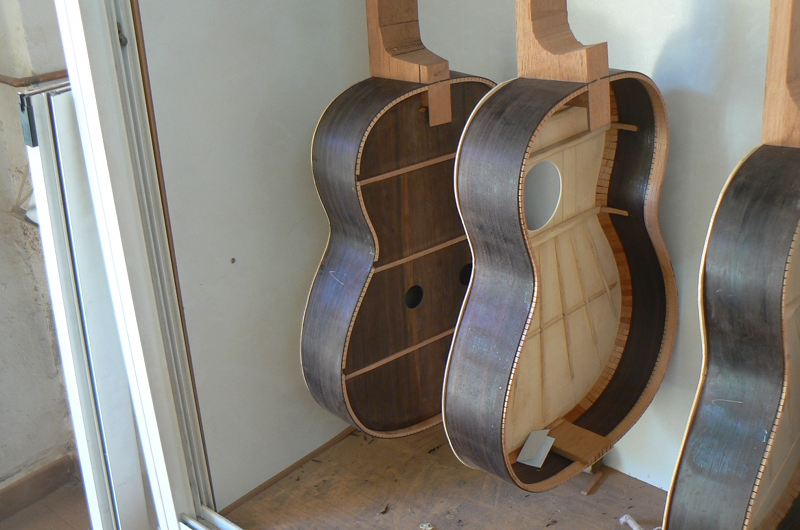
      I usually make more than one guitar at a time and I am used to seeing them hanging there but this one sure looks out of place.

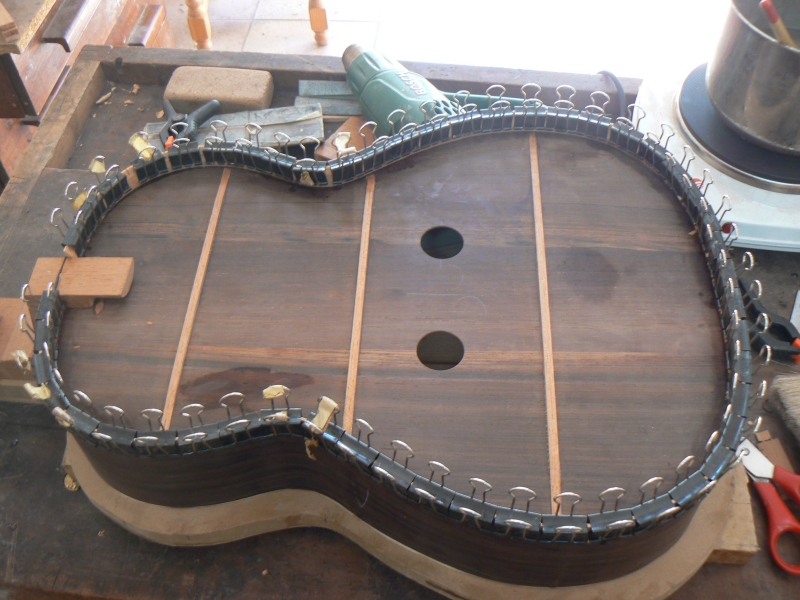
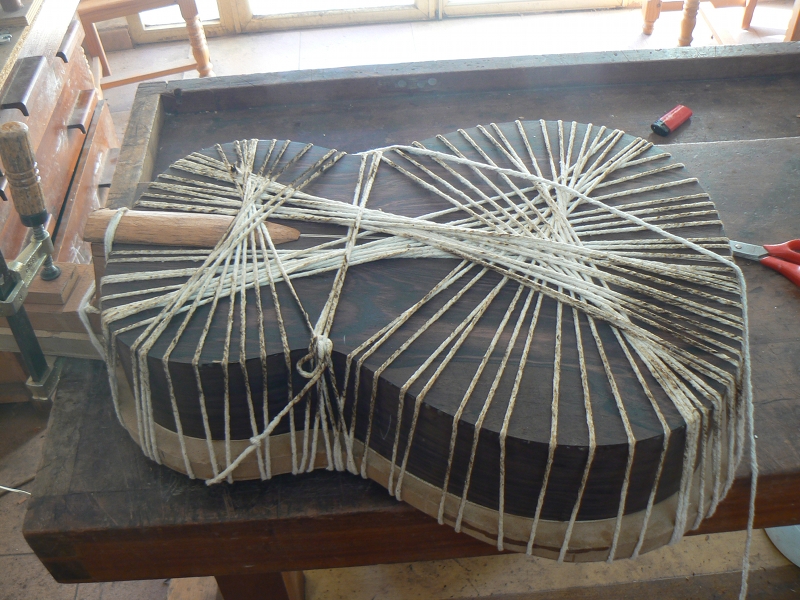
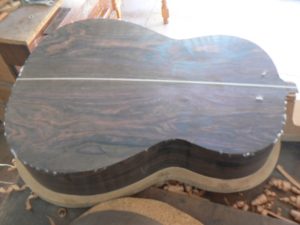
It took me ages to decide how to glue in the internal back; I never could get a look inside to see how Arias had done it.  The fit has to be very good but I had to have room to get it into the body and imobilize it at the neckblock.  I had cut shallow slots in the neck block beforehand to accept a cutout of the back but now it was very tricky getting the back into the body and at the same time Into the slots.  Next time I think I will make the cutout the same size as the block and then glue supports above and below it.  The other thing I will do differently is the endblock.  I cut the endblock short to fit only between top and internal back  and there is a small deformation where it ends.  This photo shows the back being glued on and the last one is after the string has been taken off. 

Assembly

So here is the moment of truth.  Bracing patterns are not really so important, the sound of a guitar depends so much more on things like:

-the tension of the top when the guitar is finished
-the humidity at the time of gluing
-the sequence of steps and the procedure followed

However, since I really don’t know how Arias got the results he did (a fantastic instrument with a sound and architecture that are very much alive over 100 years later) I am trying to replicate exactly what I see in the original guitar.  Many of the antiques I have played have been dead and/or the soundboard badly bellied but not this one.  For example, I can’t imagine what good the mini-braces in the foto below will do but I am using them.  Please note that they show every sign of having been glued on during construction of the guitar.  They are not crack repairs, they have the same shape as the fan braces and they are scalloped after being glued on (I can’t imagine anyone scalloping them through the soundhole). 

Madrid and Philadelphia

I just got back from Madrid, I have a new client there, Guitarras de Luthier.  Miguel Angel Cano opened this shop less then two years ago and I was happy to see another dedicated classical guitar shop in Spain.  The excellent Casa Luthier was until then the only place you could go and see great guitars by different makers and try them out to your heart’s content.   I wanted to personally deliver the first guitar I sold there so that I could meet Miguel Angel and see the installations.  We had a good chat and the shop has a great feel to it.  It is about 50 metres from the Conservatorio Superior so the location could not be better.

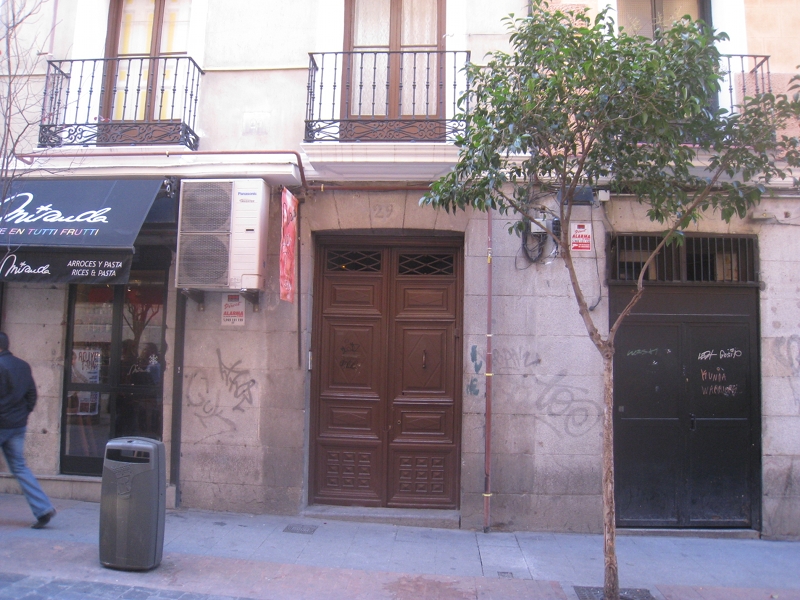
I took advantage of the trip to see some old friends there but I also thought that I should stop by Calle Huertas given that I am working on the Vicente Arias copy.  The label of that guitar from 1900 shows his workshop at 29 duplicado on Huertas street. 

Oh, and why Philadelphia?  I just sent a new Torres copy to The Classical Guitar Store in Philadelphia, I am happy to have my guitars available once again in the U.S.  I spent ten years selling guitars to Guitar Salon International in Santa Monica but just last year we found we couldn’t agree on how to continue working together so we went our separate ways.


Flamenca negra

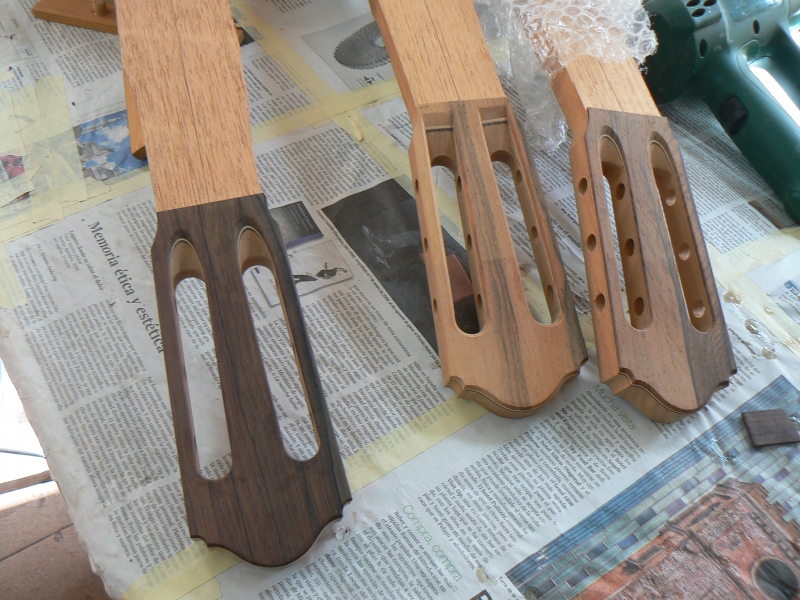
I’m quite a traditionalist when it comes to flamenco guitars, by default I use spruce and cypress although I have used coral, rosewood and maple for the back and sides.  I’ve only ever made one with a cedar top and I distinctly remember protesting to the client and offering him other options but he was sure that he wanted cedar.  The ironic thing is that when the guitar was finished his financial situation had changed and I was stuck with a cedar negra wondering if someone would buy it.   The guitar sold immediately and the people at the shop that took it said that it was my best flamenco yet so now I am willing to give cedar the opportunity it deserves.  It is the one on the left, I dug up the lightest wood I had as that helps me get the sound I want.  Not of fundamental importance but it sems to make a difference.   The bracing I use is very similar to a Barbero I saw at Casa Luthier in Barcelona, they have some great guitars in their collection.  I am trying to find some recordings I have of my guitars so watch for that.

Zoran Dukić

An excellent concert Sunday night in Granada, don’t miss him if you get a chance.  I spoke to a few friends about this concert beforehand and they were reticent about spending an hour or two with “just a guitar and classical at that”.  Well, they would have loved it, not only is Dukić a great guitarist but also very comfortable on stage, engages the audience and had something interesting to say about each piece that he played.  This guy should be named ambassador of the classical guitar.  In Spain (and maybe elsewhere) classical guitar concerts are always attended mostly by guitarists but musicians like Zoran Dukić might change that, he is one of the best choices if you want to turn someone on to guitar concerts.

I should mention his tone too.  My wife loved the “sound of his guitar” and I tried to convince her that to a large degree it is the player who makes the tone but she wasn’t having any of it.  “It sounds great, I’ll bet it’s a Granada guitar”, she said.  Well it was a Friederich so at least it’s made of wood and it did sound good.

Thanks to the Palacio de Congresos and the musical director of this series of concerts, Gloria Medina.  We don’t get enough classical guitar concerts in this city.  Speaking of which, the International Music and Dance Festival of Granada has a new director and he has been heard to say that he would like to see more guitar music in this year’s edition, we’ll keep an eye out.