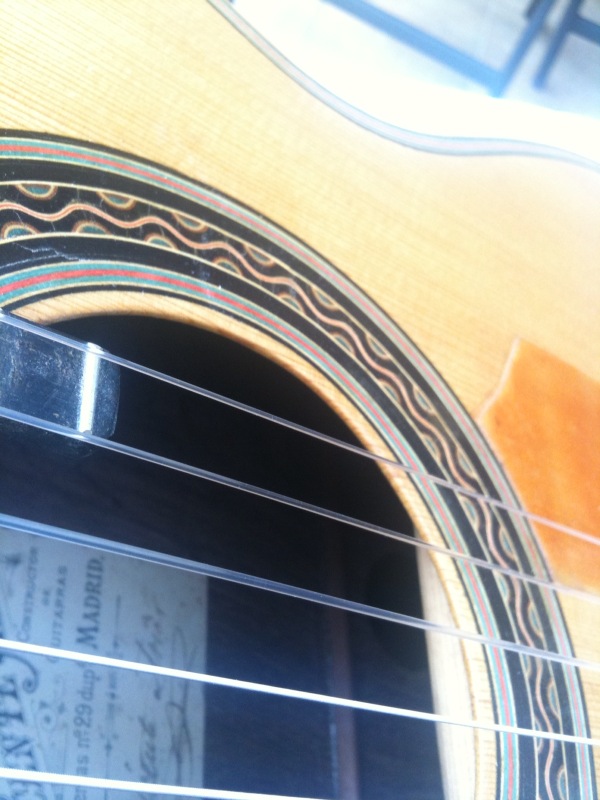
This is news (even for you English speakers) because there has never been a decent book written in Spanish on the subject; something I find quite ironic. “La Guitarra en la Luthería” by José Ángel Chacón Tenllado was published by the regional government here in Andalucia, Spain earlier this month. I am sorry to say that I have yet to see a copy of the book but I did see some of the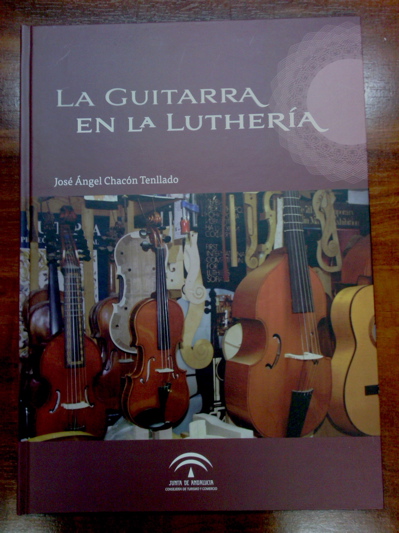 drawings and content while it was being written. Chacón was my first teacher in instrument-making back in 1990 and prides himself on being a luthier – a maker of all stringed instruments- not just the bowed instruments for which he is well-known. He developed his professional skills in Italy so for me the Italian influence combined with the violin maker’s influence enriched what I later learned here in Granada. I am excited about this book because I know how systematic and organized Chacón is so I know that everything will be explained to perfection. Teaching has been a very important part of his work ever since he returned to Spain in the eighties. And now for the baffling politics of this: There were an extremely limited number of copies printed and it is not for sale, go figure.
Author Archives: johnray
Julio Gimeno
This is an extract from a longer article entitled “El estilo español de construcción de guitarras” by Julio Gimeno García written for the Festival de Guitarra – Córdoba 2007 and published in the catalogue of the exhibition “Antonio de Torres y la Guitarra Andaluza”. Click on the picture to read the article.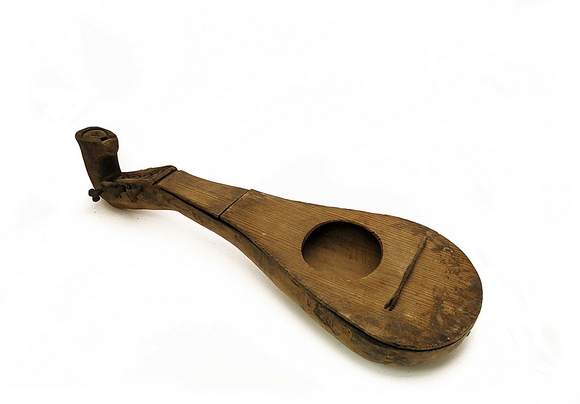
Still life with wood…
Gallery
New book by Angelo Gilardino
One of my favourite musicologists is Angelo Gilardino. He spoke last year at the Córdoba Guitar Festival where the festival’s central theme was Gilardino’s work. I was lucky enough to meet him there and also to hear the debut of his piece for flute, alto and guitar “Fiori del deserto”
His recent work with the Andrés Segovia archives is well-known but his compositions, writings and teaching have helped to shape a generation of players.
Here is a translation of the press notes from the editor’s webpage.
Curci editions has published the new book by Angelo Gilardino “Andrés Segovia – L’uomo, l’artista”
The life and career of the greatest guitarist of the twentieth century: from Linares, the Andalusian town where he was born, to the fame acquired in the most prestigious concert halls around the world.
In the background, the story of the man Segovia: three wives, four children, the Spanish Civil War, the flight to Montevideo, the looting of his home in Barcelona, the second world war, the years in New York and the meetings with many great musicians and other important figures in the musical world, to the clear decline of his new-found home.
The history of Segovia is that of a titanic protagonist of the twentieth century: around him guitar makers who built instruments which became legendary, the composers who renewed the repertoire of the guitar, the recordings, the music publishing, the respect he earned within the musical community.
This biography, compelling and well-documented, tells of a man whose destiny was to become the greatest guitarist of our time.
http://angelogilardino.com/2012/08/31/andres-segovia-luomo-lartista-pubblicato-da-curci/
The double back
This guitar is defined by its very thin, flexible top, light overall weight and a relatively small body shape but what makes it very different from other guitars architecturally is the internal back. Is that part of the secret of this guitar’s beautiful sound? I don’t think so because although the guitar is definitely something special, many guitars from that period have been widely acclaimed for the beauty of their tone; Torres before and Manuel Ramirez afterwards so I believe that it is the “the spanish construction” as well as the talent and experience of the makers that give us that sound. Perhaps the double back is analogous to the tornavoz in that it changes some character in the sound. For example, the tornavoz changes the fundamental frequency but does not make for an improvement in the musical possibilities of the instrument. As a matter of fact both these “innovations” have long since been abandoned as serious improvements to the guitar.
In any case I was asked to make a copy and making the back has its challenges regardless of whether it improves the sound or not. Firstly there is the presence of the two “soundports” in a guitar which has obviously had its back removed (inexpertly) some time after it was made. There is some very slight chip-out on the inside from the drilling of the holes so I would say they were made from the outside of the internal back. This reference of a double-back Arias guitar shows no soundports in the back. http://www.blogger-index.com/3364636-romantic-and-old-guitars. At the same time whether the internal back is designed as a part of the resonant structure or rather as a way to reduce the body volume it seems to me that making holes in it would undo those effects. As a matter of fact, someone looking to make the guitar sound like it had no second back might well do just this: make holes in the back. The only evidence that supports the idea that Arias designed the guitar with these holes in place is the presence of another guitar from the same year ( ACCORNERO, Giovanni: La Chitarra. Quattro secoli de capolavori. Italy: Edizioni Il Salabue, 2008) reported to have a double back and two symmetrically placed soundports. However both guitars were property of Gabriel Ruiz de Almodóvar and if he asked a guitar maker (Arias or someone else) to modify one guitar, why not modify the other as well?
The second question is how was the back made and fixed to the guitar? The two backs (after the removal and refitting of the one effected years ago) are so close together that a light pressure on the back in holding the guitar will cause them to touch. This is what alerted me to the fact that the interior back has bars in the outside as well as on the inside in what seems to be the same positions. It was impossible to get the magnet from the Hacklinger gauge to pass into the chamber under the soundhole of the top which would have allowed me to measure the thickness of at least that part. However, using a small block of wood and progressively widening a sawcut in it I was able to determine an approximate thickness for the internal back.
Next question: Is there any reason to give a curve to this internal back? Should the lining be parallel to the contour of the external back? Am I missing something important because I can see neither the exterior side of the internal back nor the interior side of the external back? The edges of the back will have to be completely fixed so that there is no possibility of vibration and any change in angle in the linings will have to be smooth and gradual to ensure contact throughout. I will post pictures of this process when I get to it. In the picture below you can see both the soundport and the height of the bars.