Sold

A veces mis clientes tienen más de una guitarra hecha por mi y terminan quedándose solo con una. Este instrumento ha llegado al taller hace poco y la estoy poniendo a la venta. En lugar de hablaros de la guitarra incluyo este video y pueden juzgar vosotros mismos. Es una copia de la Santos que Segovia tocaba y luego donó a la Biblioteca de la Música de Madrid. Desde que empecé a construir este modelo he aprendido más sobre la escuela madrileña de la época y sobre Santos. Creo que fué el mejor guitarrero de la historia.

En el video el propietario de la guitarra toca Scarlatti.

I have clientes who have more than one of my guitars and so of course every once in a while they sell one off or trade one for a different model. This guitar came back to me recently and I am just now offering it for sale. I won’t tell you about the guitar but rather show you this video and let you judge for yourselves. It is a copy of the Santos Hernández that Segovia played and then donated to the Music Library in Madrid. I started building this model in 2015 and it has taught me a lot about the Madrid school of the time and about Santos himself. I believe he was the best maker ever.

In the video the owner plays Scarlatti.

Domingo Esteso 1933

It is always a pleasure to get a good look at wonderful old guitars. Sometimes they come through for a restoration or an appraisal but on this occasion it was just a client who wanted to show me this gem. This guitar is typical of what we like so much from the Madrid school in the first half of the 20th century; lightly built, comfortable to play and with a great esthetic. I love this rosette! The consensus seems to be that Santos was the better woodworker but the sound of the Estesos I have tried has been top-notch. This guitar was certainly built with flamenco players in mind with its cypress body, low action and tap plates. However, my client is a classical player and finds this guitar perfectly suited to his needs.

The top seems to have a uniform thickness of 1.5mm and the bracing is the typical Torres 7 strut configuration with closing struts and nothing under the bridge.

The Irish Harp

I just got back from a holiday in Ireland. Highly recommended by the way. We had the misfortune to coincide in Dublin with the Aer Lingus College Football Classic so it was overrun with tourists. My son was amazed and very interested in the troubles which we heard all about on our trip to Belfast and Derry. Music was everywhere so of course it made me think of guitars. I often complain that none of the different levels of government here ever do anything to promote the guitar and guitar-makers despite Spain and specifically Granada being the most important centre in the world. Well the Irish do not have that problem. The official symbol of Ireland is the oldest conserved harp in the country (on display at Trinity College).  According to our guide Ireland is the only country in the world which uses a musical instrument for its symbol. It just makes me think: Couldn’t we do something like that with the guitar? I suppose Spain could use the bulls, wine, paella, some iconic image of flamenco, a fan, windmills or olive oil but is there anything more universally Spanish than the guitar?

Antonio Marín Montero

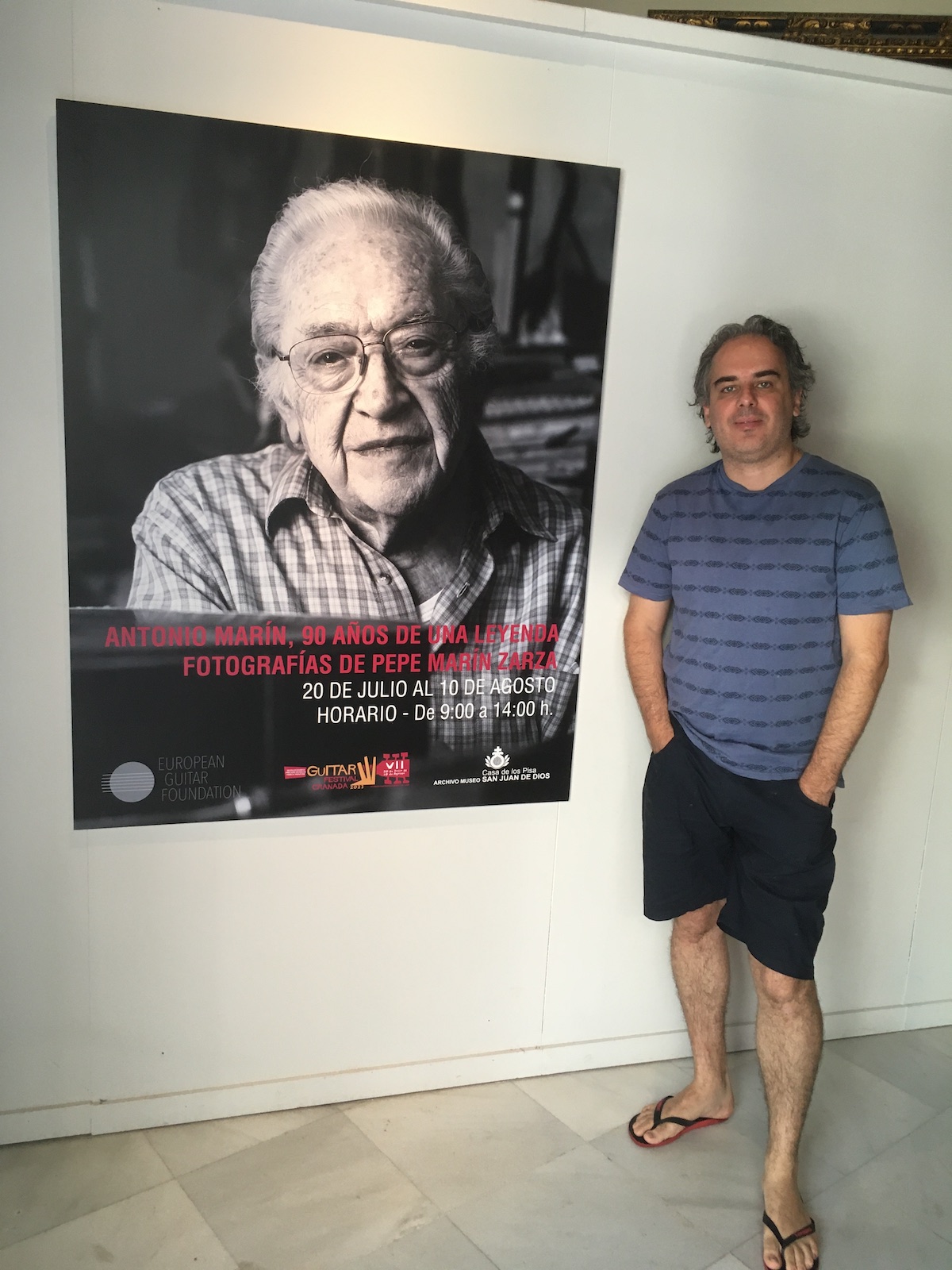
This year the guitar festival here in Granada includes an exhibition of photographs taken in the workshop of Antonio Marín. The photographer is Pepe Marín (not a family member). Once again Vicente Coves and the European Guitar Foundation are recognising important figures in the guitar community in Granada. Antonio was part of a change in the quality and professionalism of the guitar-makers in Granada in the 1960s that included others but for a number of different reasons he is the best known of those and any other makers here. The quality of his instruments, the number of guitars he has made and his generosity and sociability have made him what he is today.

The poster for the exhibition is shown here with my friend Marcus Toscano; guitarist and Spanish guitar expert.