Don’t try this at home

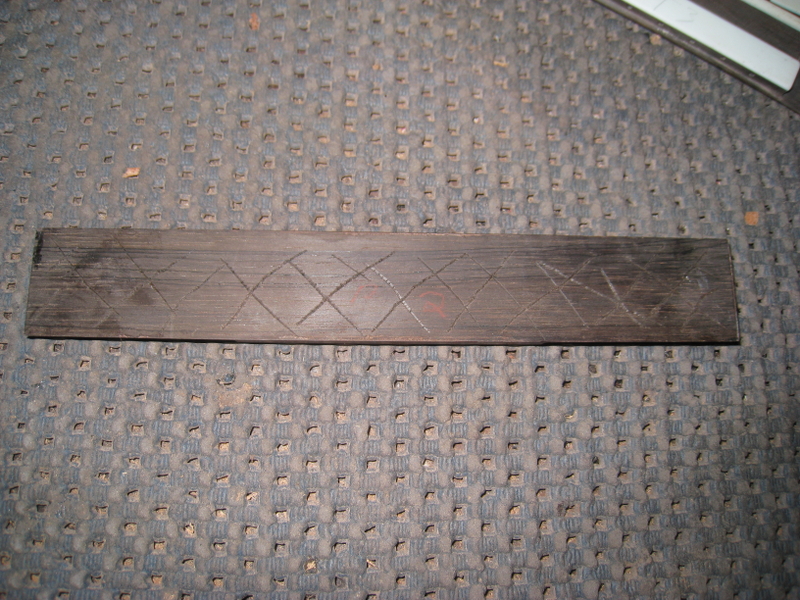
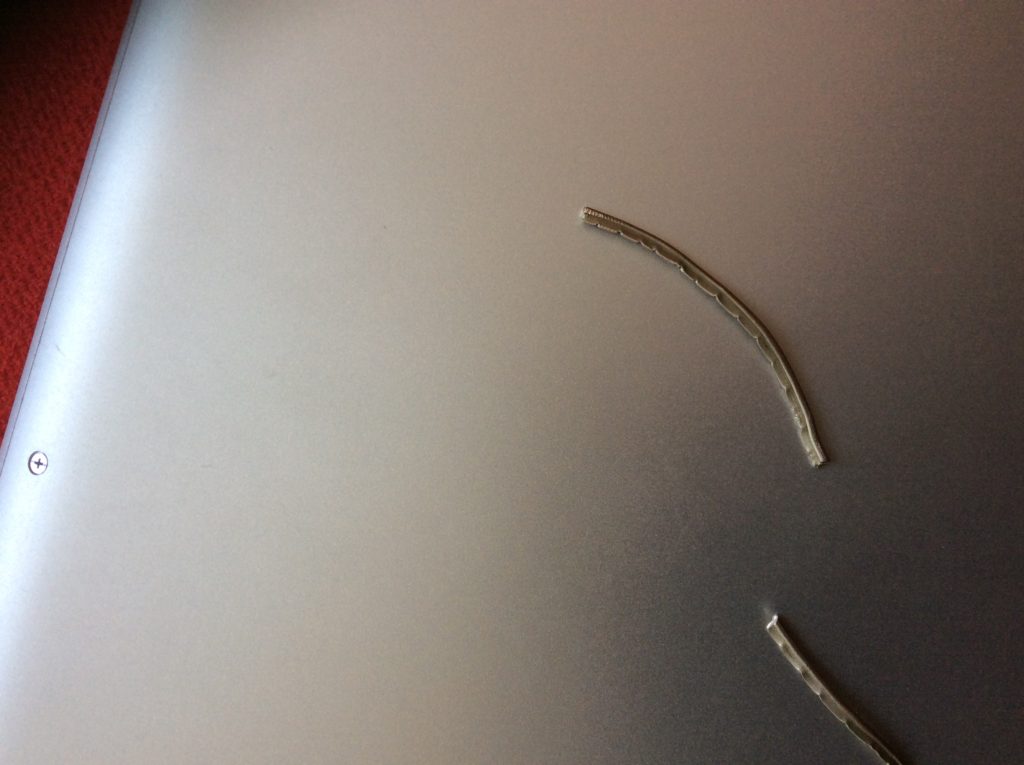
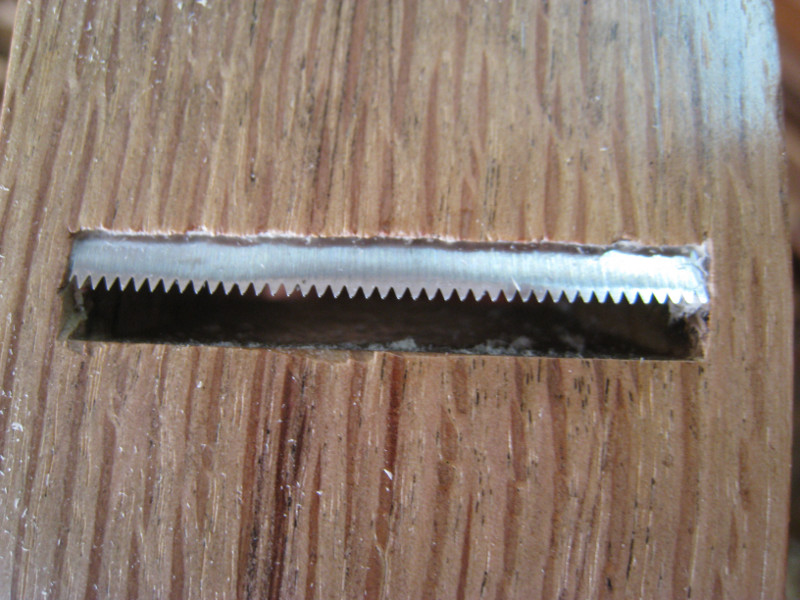
I showed a photo a few posts back of the 100-year-old fret wire that I was to use on the “gut” guitar.  The wire has no studs because it was produced by drawing it through a hole with the typical T-shaped profile.  I have seen the tool that Manuel de la Chica used to do this and it was called a “trefilador”.  A literal translation of that word would be trifiler (as in three-way profiler) The traditional way to get the wire to wedge into the fret slots is to strike the tang with a half-round file to produce irregularities on it.  In the video you can see the process which I decided to use.  The irregularities are very irregular and next time I will either use modern fret wire or a modern tool (which I have) that crimps the wire to get the wedging effect.  The frets were noticeably deformed by this process and hammering them in straight became a bit of a challenge.  IMG_0012Below you can see the photo of what was left after I finished fretting, there wasn’t much extra wire.  Sorry about the blurry video, no focus on the video camera.

Gut string update

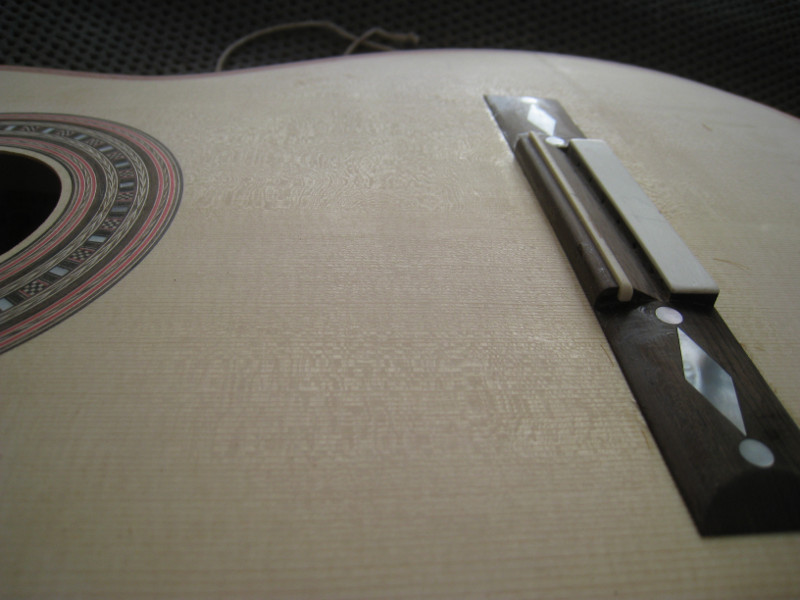
I glued the bridge on this morning and was nervous about doing it the same way as always.  I use string and wedges, no caul and no clamps.  I think I have posted pictures of it here before.  This is one glue joint that suffers from being clamped for too long, the pressure deforms the top slightly and must be allowed to spring back before too long.  90 minutes works for me.  Of course the more flexible the top is, the more it will deform.  In this case the guitar has the most flexible top I have ever built so I was worried about IMG_5562deformations and also I wanted to make the most of the bridge as a reinforcement.  In my quest to make this guitar sound better with gut strings I had not only made it more flexible but also I had used a shallower dome on it.  Obviously, the last thing I wanted to do was push the already shallow dome flatter with the glueing pressure.  I considered using clamps but my reservations about that method are even greater when it comes to a thin top so I decided against that. IMG_5564 As you can see from the photo the doming was preserved quite well by using a very soft prop inside the guitar which added just enough resistance so that the “give” in the top felt like it usually does on my guitars.  Sorry about the quality.  The last shot shows the top and you can see the silking indicating the vertical grain.IMG_5569

The Only Way to Thickness a Top

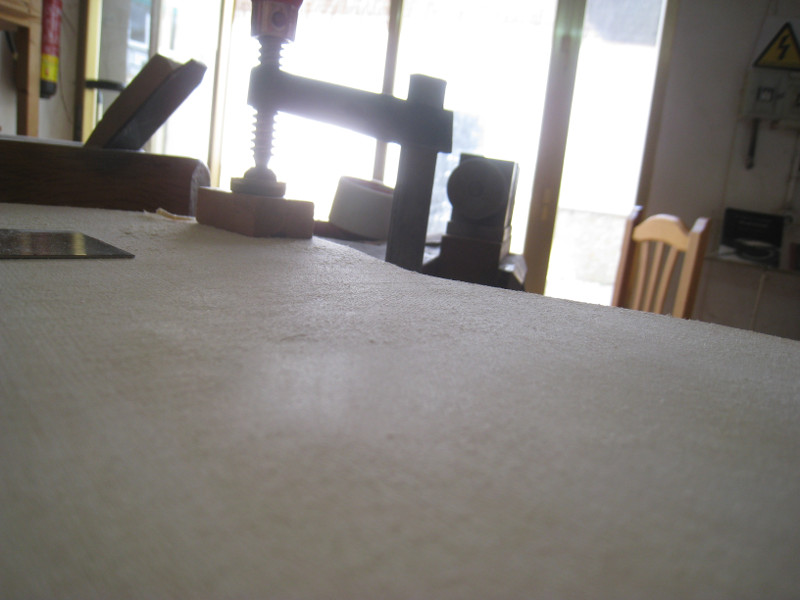
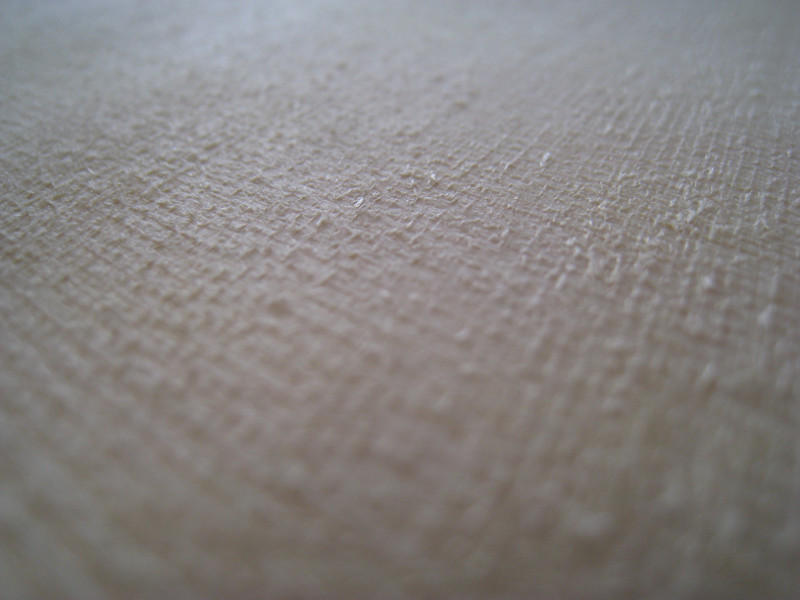
It is advisable to hand plane tops as opposed to putting them through the agressive drum sanders that are often used for the hardwoods.  Regardless of how you take the thickness down though, the last steps have to be taken in such a way as to guarantee the flatness and the uniformity of the top.  Even if you work the top to varying thicknesses at different points the transitions must be very gradual so that glueing surfaces can be made perfect.  Abrupt variations in thickness in a plate which is clamped between a mold and a bar will result in a joint with weak spots prone to vibration and cracking.   In short you need flat surfaces on each side of the finished top whether  these two surfaces are perfectly parallel and equidistant or not.  The best way to assure flatness is to use a toothing plane.IMG_5495  This tool makes marks on the high spots and leaves the low spots untouched.  The high spots are then removed with a cabinet scraper and the process is repeated.  Depending on how agressive the set of the plane is you will also be removing some material as you plane.  When the plane makes uniform marking over the entire surface it will be perfectly flat.  Careful sanding or scraping of the entire surface to remove the marks (but no more) will ensure that it remains flat.  This first surface is best achieved while the plate is still quite thick, otherwise the unevenness of the opposite side can affect the results.  Once one face is smooth and flat it can be placed on a very flat surface and the uneven side can be thicknessed and then flattened in the same way.  IMG_5493This photo shows a low spot which is not marked, and therefore more reflective, the surrounding area must be scraped and then the entire face planed again.  Below you can see the parallel marks from the teeth which show that the bladeIMG_5492 is registering everywhere.

The most important part of making and bracing a top is good glue joints and this technique will help you get those.

Building for gut strings

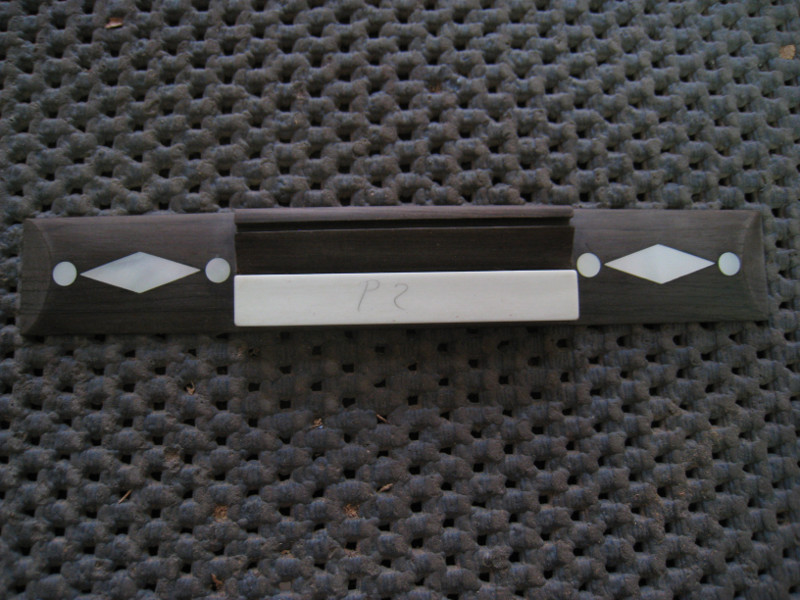
I am building guitar for a guitarist who only uses gut strings.  He has already told me that if the guitar doesn’t “work” with gut he doesn’t want it.  I wouldn’t normally accept to do something like this but this sounded like a fun challenge.  The truth is he usually only plays on historic instruments so I might learn that he doesn’t play this one much even if he finds it compatible with gut strings.  IMG_5555 This first photo shows a few of the changes I have made in this guitar with the intention that it sound better with gut strings.  Torres didn’t scallop his braces but I did so on these.  Torres linings had a triangular shape, even slightly convex in their profile.  On these I made a concave face to reduce mass without losing any width because the purfling on this model is very wide and needs support.  Other changes I made were to use very lightweight wood all round, a top as thin as I dared and to use less doming than the original.  I had considered using spaced peones but I severely dislike the small spaces left in between that break up the evenness of the interior.  I am also looking for a soft fretwire to use hoping that the strings will last longer.  IMG_5557This photo shows something that I got from another guitarmaker when I was restoring a guitar from 1900.  Intonation will also be an issue with the gut strings.  I hope to do some experimentation to see if gut needs the same compensation as nylon.

Granada as a Focal Point for Guitar-makers

Quite recently I was contacted by a film-maker and a guitar-maker (both american) about a project they had begun which would bring them to Granada to film a guitar being made here along with some footage which was to deal with the history of Granada and the spanish guitar’s deep, deep roots here.   I felt that even though the focus didn’t seem to be on the Granada guitar, the makers and their history, if I could push it that way just a little it might be worth our while.  In this spirit I agreed to lend a hand where I could.   Here is the project website where they can tell you their own story.  The film-maker is Sky Sabin and the guitar-maker is Steve Connor. The film will be very interesting without a doubt but there will be plently left to tell in the documentary about the Granada makers which remains to be made.  Any takers for that job?