
If I am not mistaken this is a tarantos by Paco, I meant to include it in the post of the same name but I couldn’t find it. This was recorded by Juan Ballesteros on a blanca I made.
Category Archives: Guitar making
Conference in Paris “WoodMusICK
The opening conference of the Cost Action FP1302 “WoodMusICK” took place in Paris on February 27 and 28 and I was invited as an instrument-maker and restorer representing Spain.
“The main objective of this COST Action will be to improve the conservation of our wooden musical instruments heritage by increasing interaction and synergy between wood scientists and other professionals (including instrument makers) applying wood scientists, curators, organologists and makers towards the study, conservation and restoration of wooden instrument collections of artistic and historic interest, and to offer a novel and reliable, independent and global knowledge on these collections”, from the webpage of WoodMusICK.
Besides being asked to lend our expertise to the rest of the researchers we were asked to make proposals for directions that work should take in achieving the main objective. I proposed that we develop a restoration protocol for the guitar because for other instruments such a protocol already in place (to varying degrees) and that the training and formation of instrument-makers and restorers be developed at the European level. This is basically because in this country many of the initiatives which have been proposed or put into practice are seriously flawed.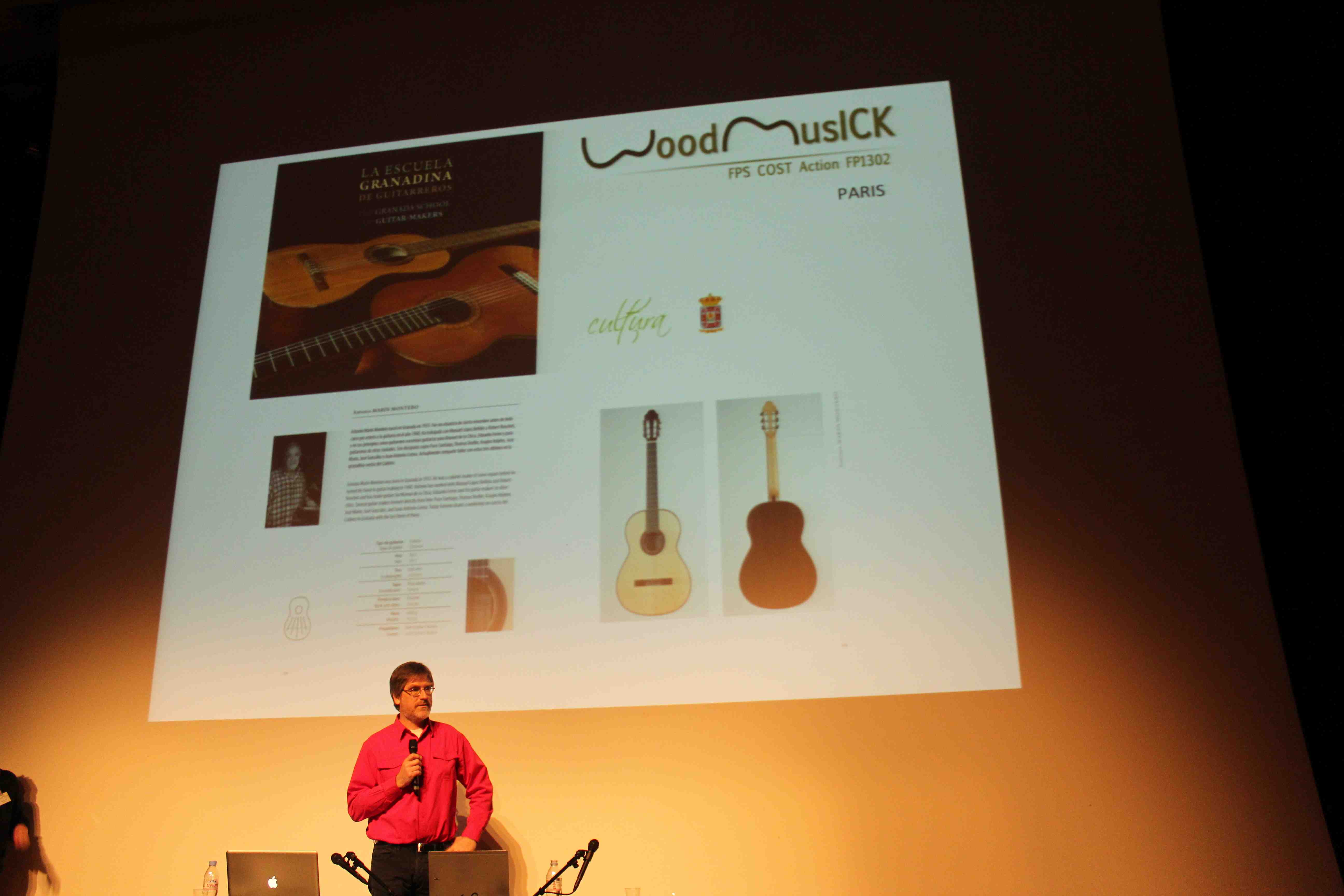
The other thing that we were asked to do was of course present the work that we had done previously. I spoke briefly about my work with historical guitars and the three years I have spent working on the book about the Granada guitar-makers. The Granada provincial government put together a draft of the book so that I had something to show for our efforts.
Highlights for me of the two days were the presentations by Paul Poletti, Claudia Fritz and Renato Meucci as well as a visit with Bruno and Catherine Marlat. Mr. Poletti is a specialist in keyboard instruments in Barcelona at ESMUC and talked about reverse engineering historical instruments. Ms. Fritz presented her latest research with historical vs. new violins which takes off from her polemic study of last year. Renato Meucci presented a very well-developed charge that we are dating, identifying and valuing old violins based on the opinions of a small group of people (appraisers/dealers) who have a vested interest in over-valuing or under-valuing (depending on the case) these instruments and suggested the use of more scientific methods.
Musical Education
My wife grew up in a little mountain village (Castril, Spain) which at the time was four hours by bus from a small provincial capital (Granada). Obviously things are different today but it still takes us two hours to get by car out to see her family when we visit. The nearest conservatory is halfway between Castril and Granada so it is a real sacrifice to get your child started with music. The weekend of February 28 we went to the the Carnival celebrations and the evening was kicked off by the town’s new marching band, some of the members of which are under 10 years old. A group of the youngest players played some solos in unison as part of some of the more upbeat pieces and the parents listened enthralled. I had never realized the power to educate (in so many ways) that a band has. (With a good director) you are teaching the children respect, working together, listening to the other instruments, responsibility in caring for their instruments and of course having others are depend on them can be very motivating. My niece and nephew here are in the band and what they have learned to play in a very short time is very impressive. I have always preferred the guitar or bowed instruments and if I had given much thought to what I might “offer” to my 6-year-old I had always thought in terms of those instruments. Well now I am thinking about a wind instrument in a marching band because of what I see these kids learning and enjoying through the town band.
Paco de Lucia
The news of Paco de Lucia’s death caught me driving to the airport on my way to a conference http://woodmusick.org/ in Paris and I just got back. I was not a flamenco aficionado by any means as I learned to play the guitar but I am not sure that any flamenco at all was being listened too in my neck of the woods. When I moved to Spain in 1989 wanting to become a guitar-maker flamenco was present everywhere in the culture here and became a part of my life. I took some lessons, built my first guitar out of cypress and began listening to Paco de Lucía. I had one cassette on which he accompanied a singer whose name I can’t remember and I was completely hooked. I am sorry to see Paco go so soon.
The role of weight in Flamenco guitars
There is a certain amount of obsession over the weight of flamenco guitars, some think it helps get that flamenco sound and others like the feel. I like a lightweight flamenco but never at the expense of wood quality or the required thickness of the different components. What I will do sometimes when I am preparing necks, bridges, braces or anything else is put aside the lightest pieces for the flamencoes. The difference is often very slight and I might even weigh some pieces with a kitchen scale to find the very lightest ones. I don’t think it makes a big difference but if it gives the guitars a special something then why not?
A very important aspect of the comfort of a guitar, perhaps more so with a flamenco, is balance. The weight of the neck and headstock can become very important to the player as it relates to the rest of the guitar. Again, differences are not huge but guitarists can be very sensitive to slight variations. Some builders try to find lightweight tuning machines and others prefer to use pegs. A thread on this very subject at foroflamenco.com and the fact that I was recently preparing necks made it convenient for me to do a little experiment. We know that a guitar with machine heads will be heavier than the same guitar with a peghead but by how much? One member even suggested that the wood eliminated from the headstock on a machine head guitar balances out the added weight from the tuners (not so) It was quite easy for me in the process of preparing a number of necks to weigh one just before drilling the holes and cutting the slots and then to weigh it again afterwards. For the first weighing I drilled and reamed six peg holes which would later disappear when the slots were cut.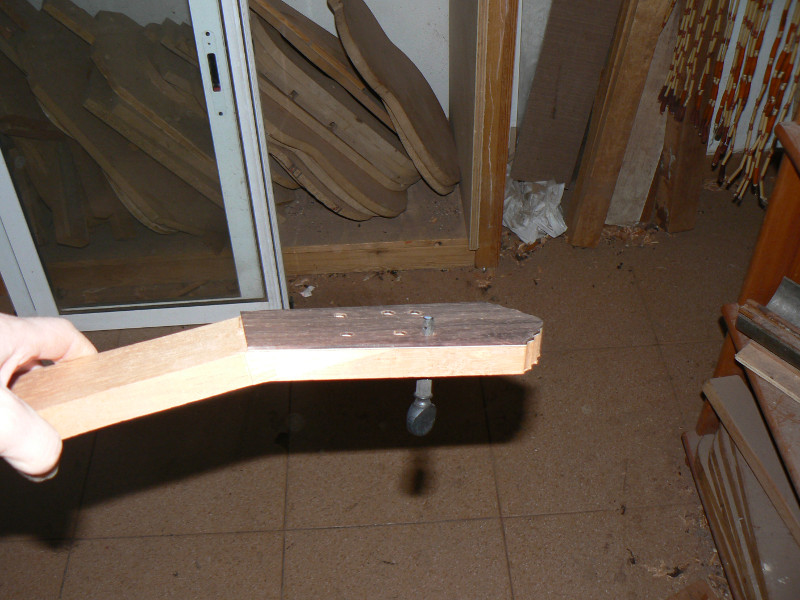 If I were to drill the six holes in their correct positions they would not all fall within the slots which I would later cut. This gives us a good idea as to the difference between a peghead and a normal guitar although we should keep in mind that the wood used for the pegs can vary in weight, size of the pegs themselves is relevant, pegged headstocks are traditionally thinner than a normal head and so show even more difference in weight. I tend to keep them the same thickness because is makes conversions easier for the poor fool who has to do it when the player decides that the pegs weren’t such a great idea after all.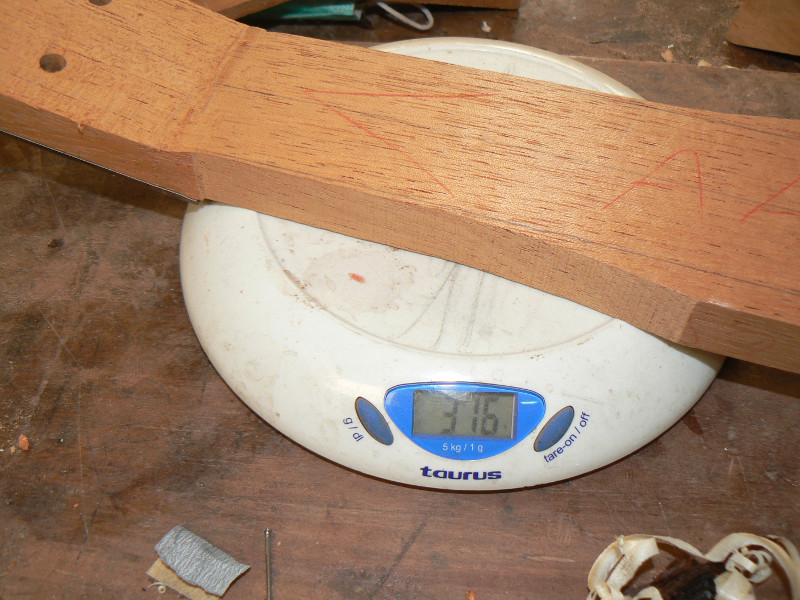
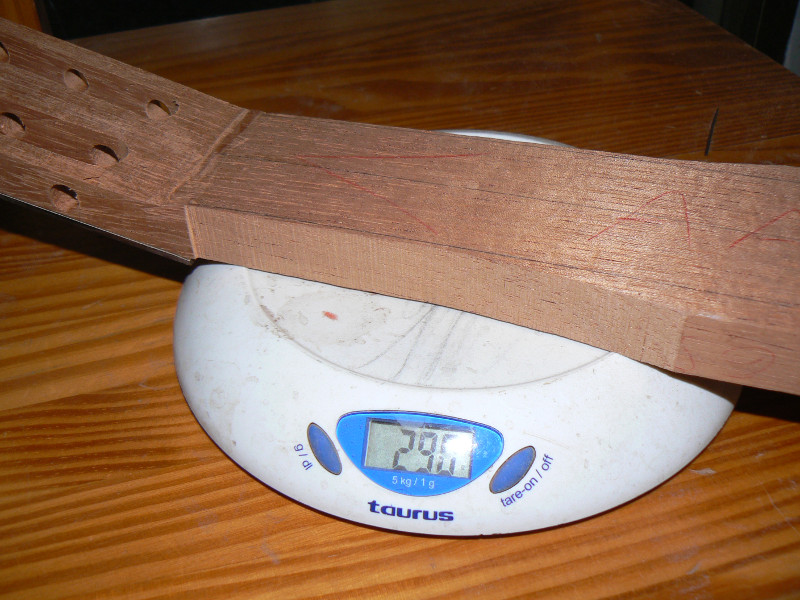
The neck looks different in the two photos as one was taken with flash and the other without. The neck with peg holes weighs 316 g and the slotted head weights 296 g
One possible solution to the balance problem is to install Pegheds as I have done on this guitar. They give you the look of pegs, they are lightweight but have internal gears and are easy to use for those who panic when they see wooden pegs.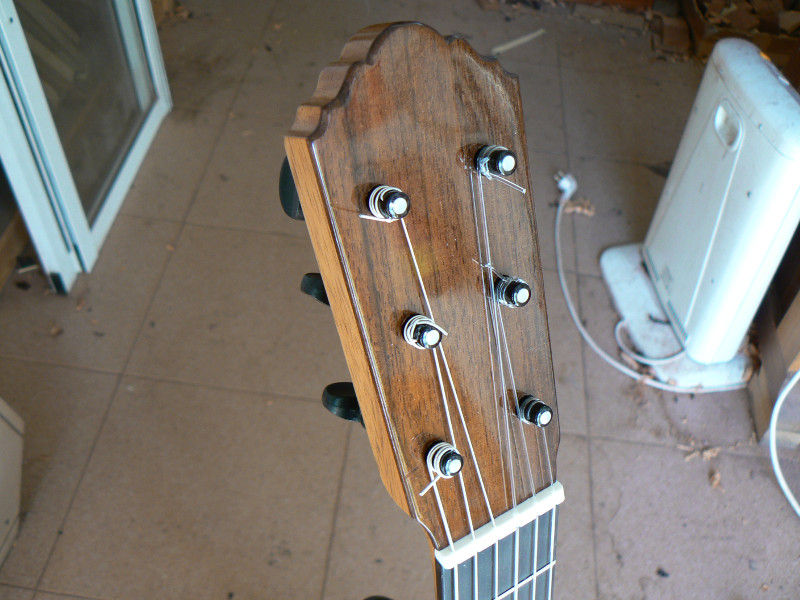 If machine heads are the only way to go for you you can try to find the lightest ones that fit your budget. Here are a few that I had in the shop at the time
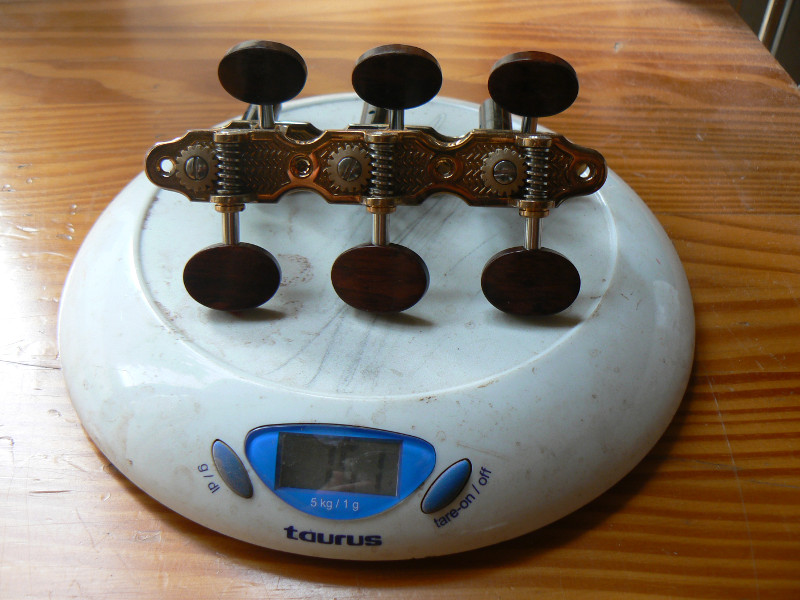
Sloane 151 g
of my testing. The Sloanes are the old ones without the bearings which makes them a bit lighter although these are the longer model. I was disappointed with the Gotohs as they are touted as being very lightweight. I have never been impressed with the quality of Gotoh so I can’t imagine that these are any better. I would imagine that the Rodgers will vary in weight with the different styles that they offer. And what can I say about
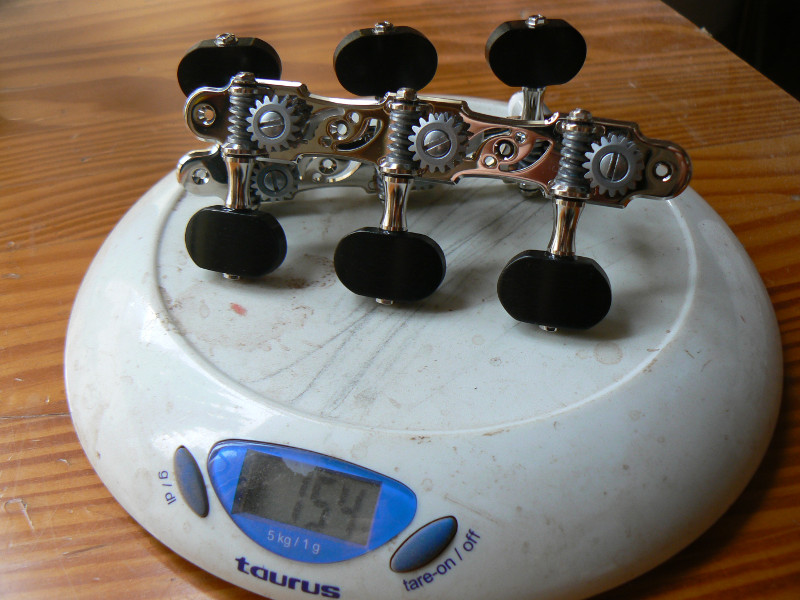
Gotoh 154 g
the Schallers? They continue to be squeaky but they tend to work well enough and not develop problems over time which is more than I can say for some. For comparison I weighed the pegs also and the nice ebony ones shown above weigh 32 g for the set. A set of 9mm Pegheds (2013) weighs 72 g so now we can make a decision about what to use. The head with the Gotoh tuners shown will weigh 154+296=450.
The head with wooden pegs will
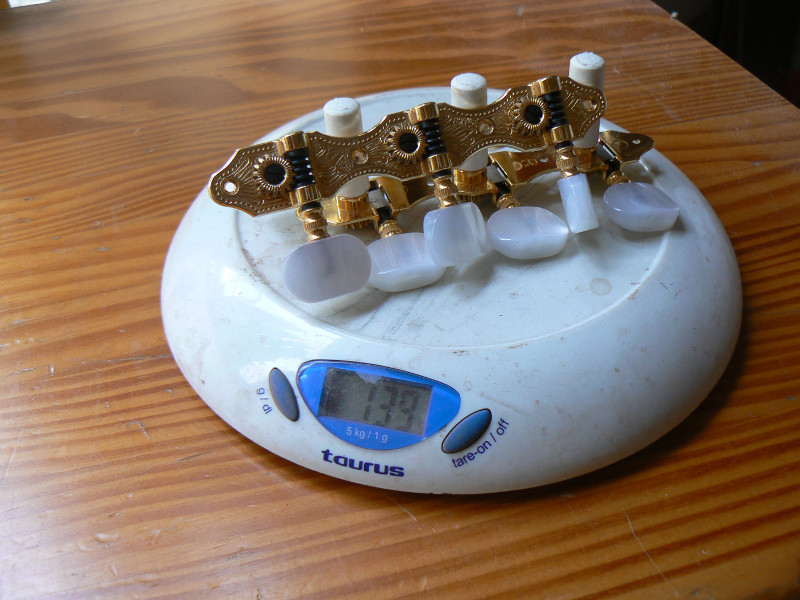
Schaller 139 g
weigh 32+316=348 and with pegheds it will weigh 72+316=388 so either way pegs make for a lighter headstock which will make a very lightly built guitar more balanced and therefore comfortable to play.
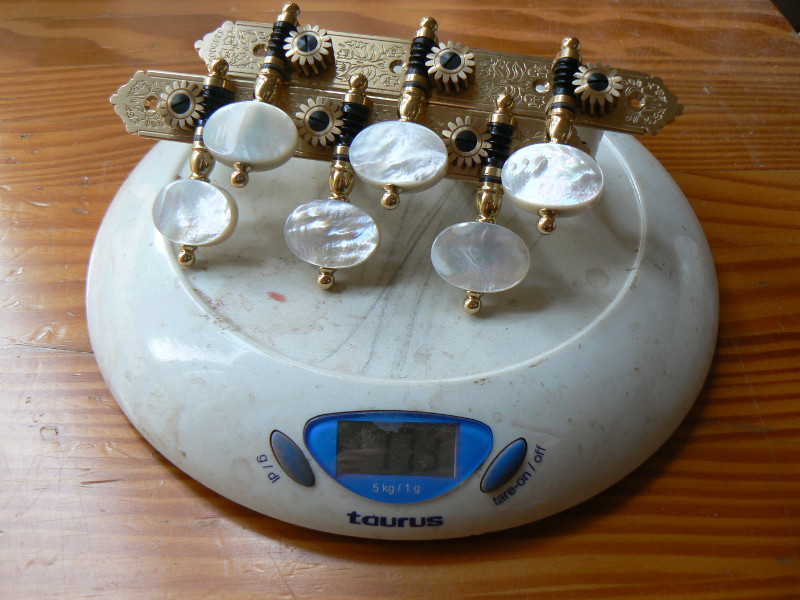
Rodgers 173 g