
I have been known to criticize dealers both in general and specifically but let the record show that I know how important they are and the better ones can be very good for the artisan’s visibility. In general those who do what I do are not especially good at self-promotion. The guitars might be fantastic but these days marketing, visibility and who is playing your guitars is sometimes more important than how they sound. You might think that with cheap flights and no borders within European countries that it might be no more difficult to find clients in other countries than it is here. Well, actually, there are an incredible number of guitarists who will only visit the guitar shops in their region and might never buy a guitar from the person who made it. Therefore I am happy to report that my guitars are now available in France thanks to Jean-Marc de Beys at Guitarreria.eu He travels around a lot especially within France and Belgium so getting a chance to try the guitars he carries shouldn’t be too hard. He has just received a concert guitar of mine in spruce and indian which sounds sweet and strong.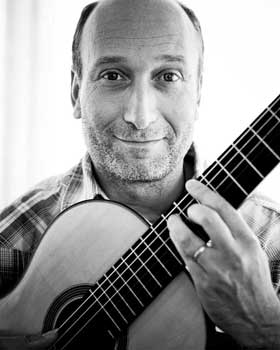
herringbone
One of the most time-consuming things in my Torres copy is the herringbone in the rosette. First you have to make it, ensure that all of the points come together and then be sure that the centreline conincides with the middle of the top. Unless you are willing to accept imperfect “arrowheads” the way this guitar-maker was (see the way the interior herringbone is completely shifted and asymmetric) or you are willing to throw a lot of strips away after glue-up then you are stuck with doing it the only way that guarantees results: 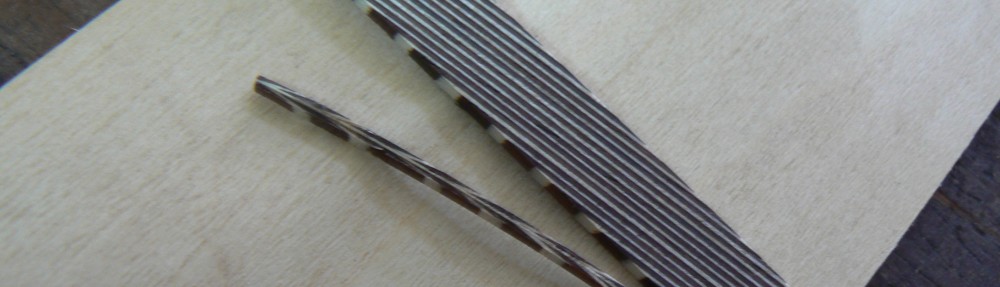 one strip at a time. The trick is to work with your final rosette depth (say 2mm), cut off a strip, flip it and then glue it back on to the larger piece after lining it up perfectly. Then you cut it off again and thickness
 it to the point where both sides are equal.

Now prior to this you have to glue up alternating veneers and then cut them at an angle to get the half herringbone stock in the first place. Some lutherie texts suggest you work with full height like what you see in the last photo and then slice off the full herringbone strips but I can guarantee you that your points will not all line up. Actually, having a thin white strip in the middle allows for a bit of imperfection because it is not quite so visible.
Manuel Reyes
This week we lost another great of the guitar, Manuel Reyes of Córdoba. Recognized by most as the greatest builder of flamenco guitars, his talent and popularity was another stone in the monument to the traditional spanish guitar. When I met him he seemed to be a very intuitive builder (as opposed to the scientific trends we see nowadays) and was very clear that his place was with the flamenco guitar. He even went so far as to ask himself what he needed to change to make a great classical. This conversation took place in Granada when he travelled here with his daughter Manuela to buy wood from my teacher Rolf Eichinger. We all had lunch together that day and I I remember Manuela being very excited and passionate about the craft she was learning from her father. I met Manuel once more in Córdoba on the occasion of the Festival in 2007 when we were both asked to exhibit a guitar for the hommage to Torrres. If you search “Reyes” one of the first photos to come up is of Reyes with Romanillos and Andrés Dominguez and was taken at the opening of that exhibition.
I am sad to see him go and I wish all the best to his son Manuel and his daughter Manuela.
Carlos Blanco Ruiz
Remember this guitar? https://johnguitar.com/manuel-ramirez-1911/ Well, Carlos has just used it on another recording and I have now received my copy of the cd, very nicely played and well recorded. You can get it here although I am not sure if they ship outside of Spain. On the same page you can download the booklet and listen to quite a few tracks.
Carlos Blanco Ruiz
Manuel Ramírez, 1911
Instituto de Estudios Riojanos, 2014
The Instituto de Estudios Riojanos published in 2005 the book and CD “Francisco Calleja (1891-1950): Música original para guitarra. Edición Crítica” and in 2012 a second cd “La guitarra de Francisco Calleja: nuevas obras y transcripciones”, both authored by Carlos Blanco Ruiz.
The first project contained a biography, editions of the known pieces and a cd of this music. The second contained new music both originals and transcriptions.
We now present a third recording with music that is related to Francisco Calleja. There are a few things that justify this new publication:
On the one hand we have the appearance of new repertoire, recently discovered. On the other hand is the possibility of displaying the aspect of performer through Calleja’s transcriptions and other pieces which are not his but were often present in his concert programmes in his almost 40 years of performing.
Several of them are mainstays of guitar repertoire from the beginning of the twentieth century. Finally, but no less importantly, the possibility of studying and recording these pieces on a historical instrument, a guitar made by Manuel Ramírez from 1911 which belonged to the maestro and still retains the sound of these increasingly appreciated instruments. The so-called historical guitars have a characteristic “spanish sound” which allow us to understand the music of the period (in which they were built) in a different way. Our challenge was to ensure that the recording captures those special timbres in an attempt to offer a complementary vision of guitar music from the essential first decades of the twentieth century but seen through the eyes (or ears) of Francisco Calleja (from La Rioja). LA GUITARRA DE PRINCIPIOS DEL S.XX BAJO EL PRISMA DE FRANCISCO CALLEJA was recorded in June of 2012 in Studios MECA, San Asensio and the sound technician was Javier Rojas Ruiz.
Below is a video from the recording sessions.
Antonio Marín Montero
People from all over the world know Granada for its guitars but here in our own city, until this year we have had no official recognition. The Granada provincial government (publishers of the guitar-makers’ book) has once again risen to the occasion. Here is the official act during which Antonio Marín is awarded a medal by the province of Granada. Start watching at 9:17.