I have always made a high proportion of 640 instruments as they sound great and the earlier instruments have encouraged guitarists to order one. 630 has not been so popular but recently I have had a few people asking and seen some discussions online about where to get a 630 guitar. It seems there is a scarcity of quality short-scale instruments and players are forced to buy mass-produced products that are often made in China under an American name. Ordering a short-scale from a maker one trusts should be an obvious option but for some reason guitarists are nervous about how it will turn out.
I have a smaller mold made by my teacher for short-scale guitars that I have never used and so I thought that I would make a 630 scale and see if there is a serious market. The top is very nice and stiff and the wood is special as I decided not to use Indian rosewood for this one.
I don’t have this blog open to comments because I am sure I wouldn’t find the time to approve them before they go up (you know, spam). However, I do get some feedback by email and facebook, here are two messages about the last post. I’ll have to take more care to get my information first-hand in the future. Here is the webpage for the Romanillos museum.
Dear John, Thanks for your post. I agree it is a real shame that the craddle of the guitar does not have a true museum.
Just to let you know that I visited the Siguenza- Casa del Doncel museum on May the 28th, and it is open, and I had the opportunity to meet Romanillos himself.
There has been budgetary restrictions, and now the exhibite only has 8 of the 16 guitars/vihuelas previous exposed. Romanillos had to take them back…
He commented that it is giving him and his wife a lot of trouble as both city halls, Siguenza and Guadalajara don’t care much about it.
The Santos Hernandez workshop reconstruction is there. If it is going to close in the near future, they didn’t say.
Hi John, I think you underrate La Casa in Seville. While it is ‘private’ you are allowed to walk in any time there is no show on and have a very good look at a wonderful collection of guitars. I found it a better collection and easier to look at the guitars than the museum in Barcelona.
Peter McIntyre
Thank you so much both of you for the corrections.
Spain: birth-place of Andrés Segovia, Paco de Lucia, Antonio de Torres, Santos Hernández, Francisco Tárrega, Fernando Sor, y el flamenco. If any country should have a national museum of the guitar, Spain is it. True, there are a number of private collections but the only decent public collection of guitars is in the Museu de la Musica de Barcelona along with musical instruments and documents of all descriptions. The Antonio de Torres museum in Almeria doesn’t have many instruments of its own and so depends on loans from private collectors. I don’t think they have a single Torres. La Casa de la Guitarra en Sevilla is a private “museum” which has flamenco shows and a shop which buys and sells guitars. Ronda Guitar House has a collection of many different kinds of instruments and offers courses and concerts. The Romanillos collection is at: Centro de la Vihuela de Mano y La Guitarra Española “José Luis Romanillos” in Sigüenza. Under the present government the Museum is open every day; in the morning 11 a.m. to 2 p.m. & in the afternoon from 4 p.m. to 7 p.m.
It is beginning to look as though no one in government is going to put up the money to fund a full-fledged guitar museum in this country so we have to look at other alternatives. The MIMMA (Museo Interactivo de la Música) in Málaga is a model we might look to for a guitar museum. The MIMMA is an interactive museum of music, musical instruments and experiments so it is much more hands-on and child-friendly but the model of how it came about is useful.
The collection is private but the beautiful, recently refurbished building has been provided by the town council of Málaga. In one newspaper article the projected cost of the purchase and renovation of the building was 3 million Euros. Couldn’t Madrid or Granada as centres of guitar-making, Córdoba as the location of the most important guitar festival in world or the central government create a museum? Marcelino López Nieto has famously said that he will donate his collection (one of the best in Spain) to a museum in Madrid on the condition that it stays in Madrid. What are you waiting for, Madrid? Another of the great collections in Spain was sold off piecemeal between 1990 and 2000 mostly to Japanese collectors. Is Spain’s cultural heritage only important to those outside Spain? A sad state of affairs indeed.
Japan has a guitar museum, El Palacio de la Guitarra, with a great collection of instruments, many of which belonged to the Granada guitarrist and teacher Manuel Cano. What about Spain?
“This all began at Buffalo 1st edition of Women of the guitar. We were having a roundtable with Martha Masters, Gohar Vardanyan, myself and Joanne Castellani. Joanne were asking so many interesting questions and we came to the conclusion that they are many women playing the guitar and they needed to be more exposed. I hate to complain so I promised that I would raise a big list of all the women playing the guitar around the world. Here we are one year after that promise and the list keeps growing.”
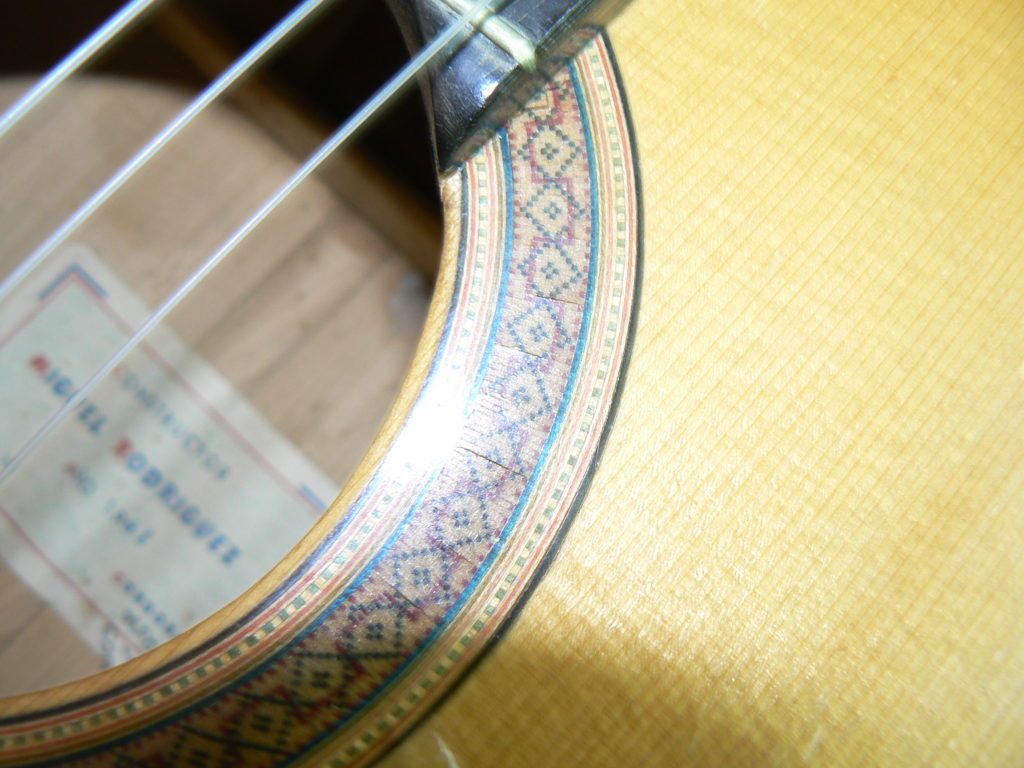
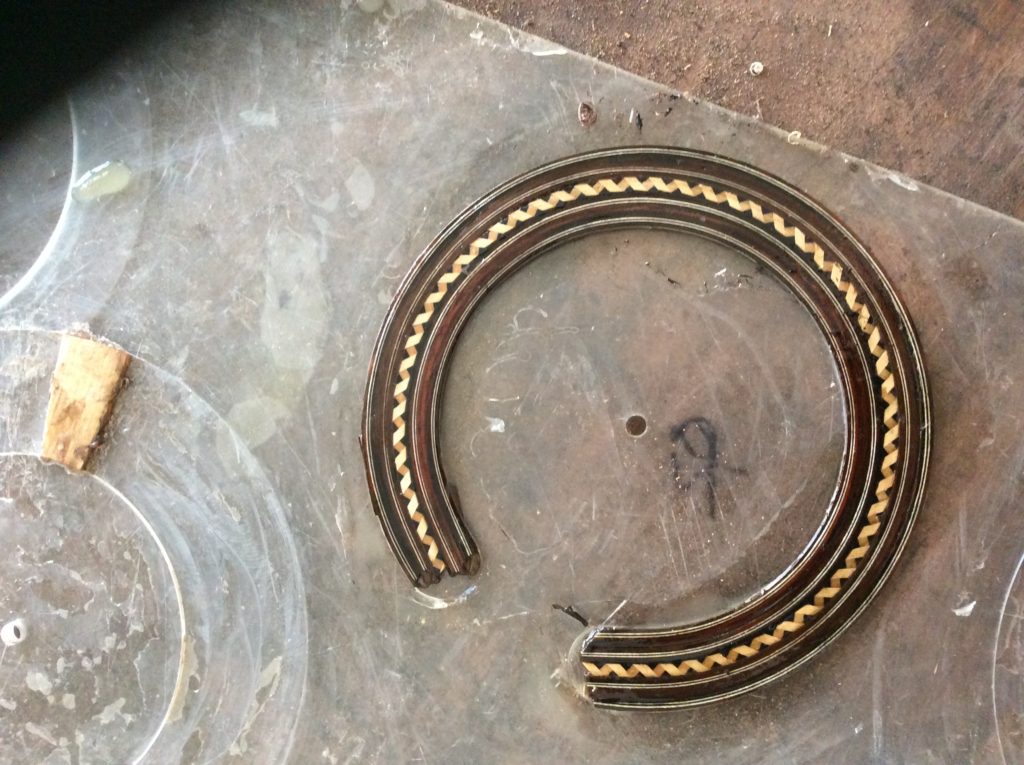
The traditional mosaic tile rosette uses end grain and can be elegant, precise, tasteful or even blocky and simple. What it can never be is bright with shiny white (or other light colours). The open grain of the wood makes the whites darker. End grain is used so that you can make up long “logs” and slice many tiles off. It is also easier and cleaner to plane, scrape and cut the wood or veneer along the grain as you prepare the mosaic logs. So if you want a bright white what can you do? Obviously the answer is to change the orientation and use side grain. This rosette is not a traditional mosaic but uses a combination of side and end grain to beautiful result. The side grain retains the colour of the wood and the end grain is darker (here largely due to the glue but later due to the varnish).

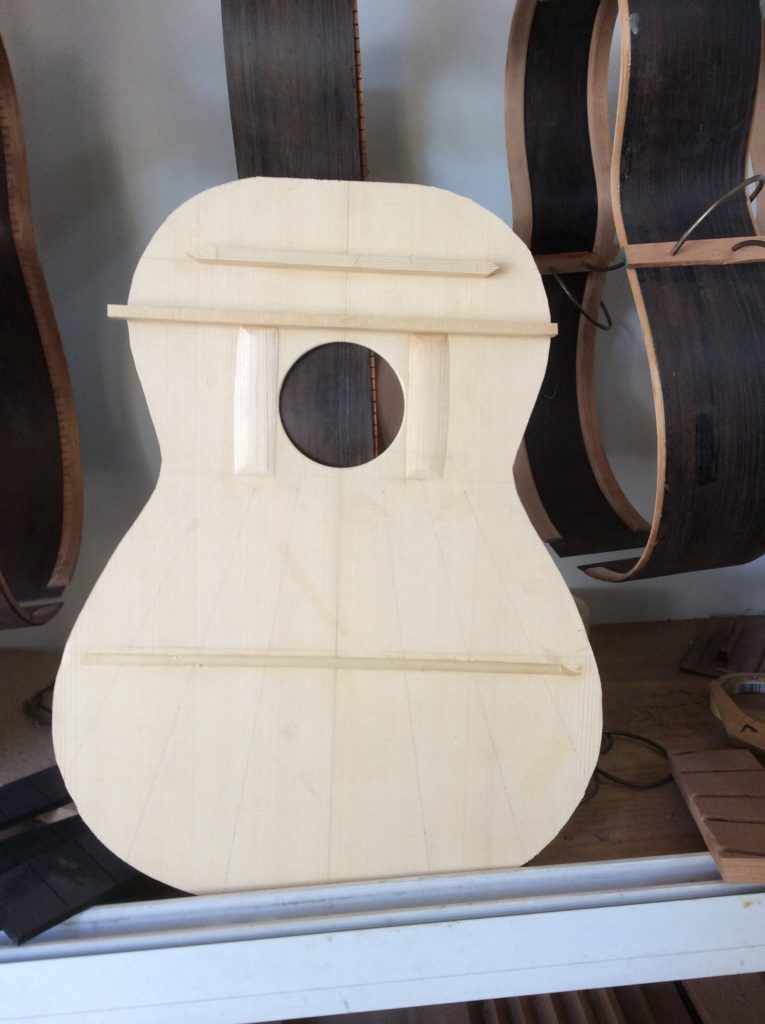 I have a smaller mold made by my teacher for short-scale guitars that I have never used and so I thought that I would make a 630 scale and see if there is a serious market. The top is very nice and stiff and the wood is special as I decided not to use Indian rosewood for this one.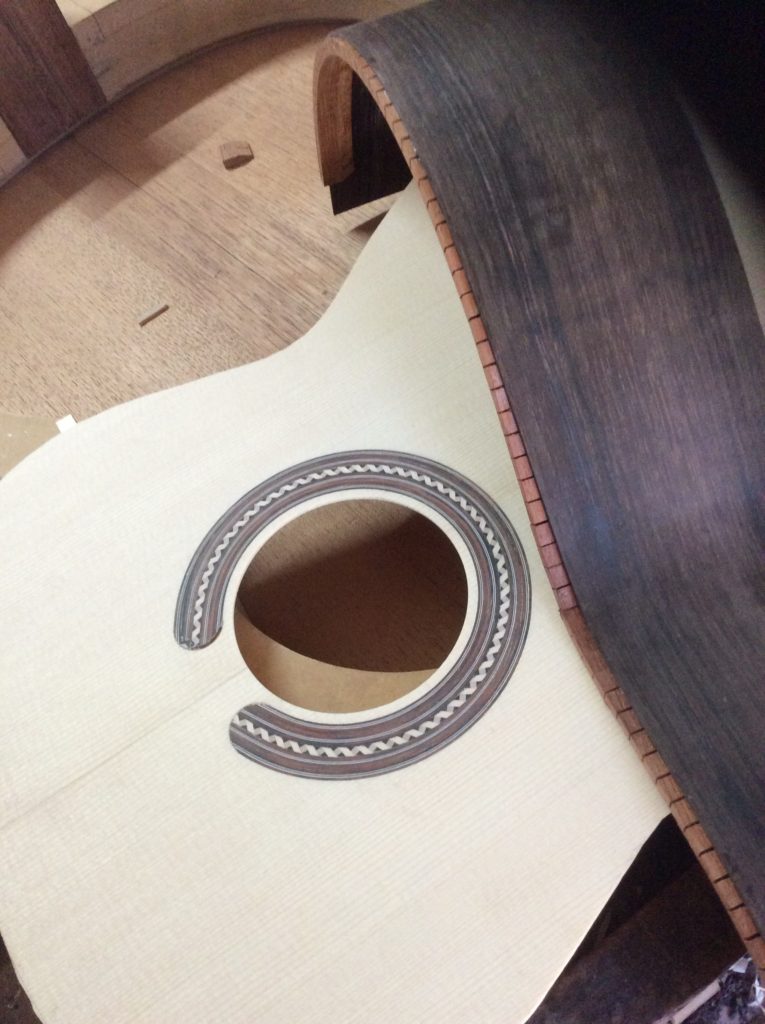
 I don’t have this blog open to comments because I am sure I wouldn’t find the time to approve them before they go up (you know, spam). However, I do get some feedback by email and facebook, here are two messages about the last post. I’ll have to take more care to get my information first-hand in the future. Here is the webpage for the