Enrique García 1913

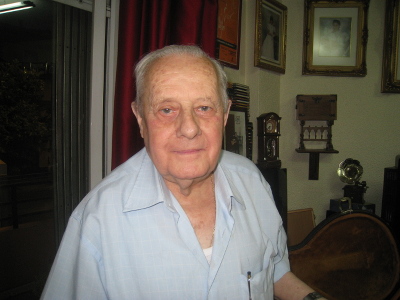
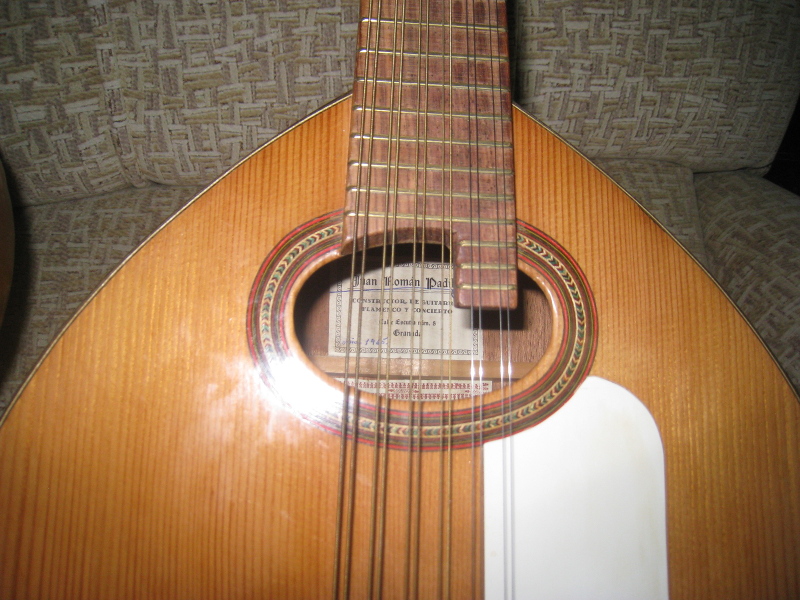
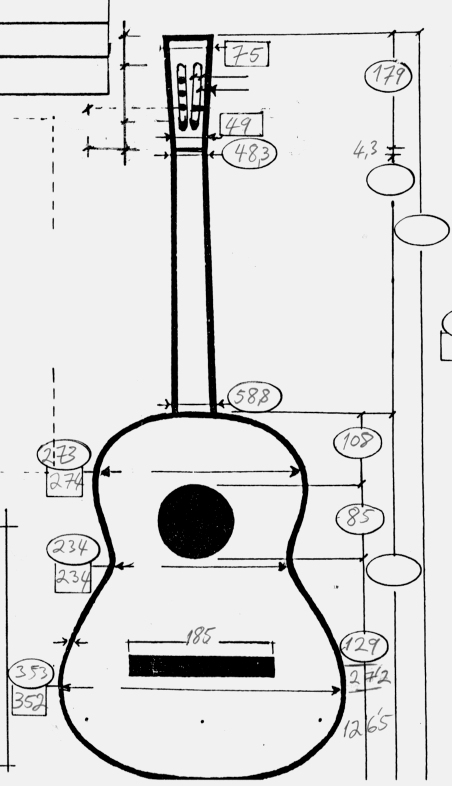
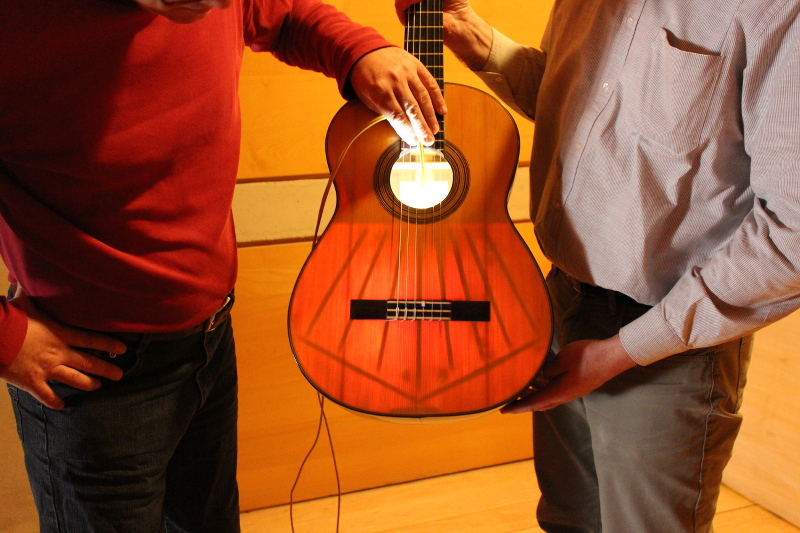
Enrique Garcia was the son of a guitar maker, Juan Garcia, but he is said to have served an apprenticeship with Manuel Ramirez, and worked for him until 1895.  García is also famous for his one disciple, Francisco Simplicio, during his time in Barcelona.  I was able to examine this guitar at the Music Museum in that city.  The guitar is in very good shape and shows, not surprisingly, some similarities with Torres work.  Below are some of the measurements if you are interested.  I may never make a copy of García but Rolf sometimes used a plantilla and bracing taken from a García he had examined.  I don’t remember the bracing being assymetric like this one however.  Once again the technique of the low-watt bulb inside the guitar shows us very clearly that he thought that the treble side would benefit from more braces. 

Instrument-making texts

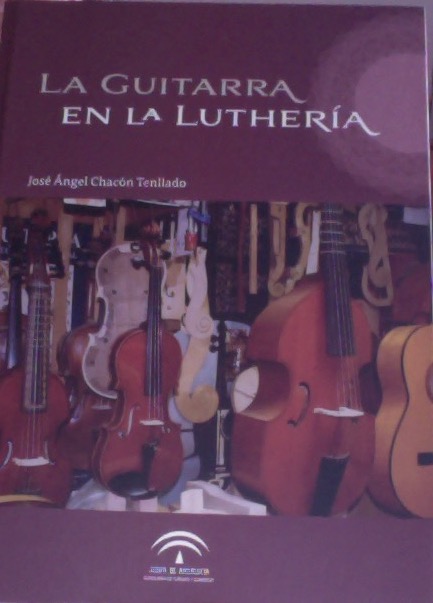
In October of last year I posted about a new guitar-making book that had been published in Spanish.  The book was never offered for sale because it was a government sponsored edition and very few were printed.  It is just as well actually because the new version is better, has more information and a different cover photo (something I am very happy to see).  One of the additions is the explanation of the traditional method of construction although the original text laying out José Ángel Chacon’s approach is still the basis of the book.

La guitarra en la luthería

Chacon developed his skills as a luthier in Italy in the seventies and is perhaps better known as a luthier of bowed instruments than as a guitar-maker.  For this reason I also mention his book on the construction of violins which is also available here.

El violín, la viola y el violonchelo en la luthería


David Russell

David Russell played last week to a full house in the Arrayanes patio in the Alhambra.  If you know his playing and you have been to the Alhambra you can stop reading right now, you can imagine just how perfect the evening was.  Here is a photo and an article in from a Spanish newpaper.  Russell’s musicality was, as always, inspiring and his ease with the music and the audience rounded out the performance.  Some say he is the best player alive and that may well be true, I have lately been trying to encourage people in my circle of friends to go to guitar concerts and have not always been successful in getting a positive reaction but this was a great success.

I would like to publicly congratulate the director of the Granada International Festival of Music and Dance on his determination to give the guitar a place in the programming.  It has been years since we have seen guitarists of Russell’s calibre at this festival but this year we get the top classical player, the top flamenco player and the winner of the Andrés Segovia contest.

Now I hate to say anything negative about what might be the best guitar concert I have been to in Granada but I can’t help myself.  If I hadn’t seen David walk on stage with his guitar in hand I would have sworn that the guitar had a transducer pick-up under the saddle.  That was exactly the sound that it had!  I was not in the front row by any means so I was hearing the amplification mostly but I have never heard a guitar amplified through a microphone sound that way.   Another thing I noticed is that I heard that sound quality all the way through the concert.  I have been to guitar concerts where my first impression of the sound or volume of the guitar was not good but after 10 or 15 minutes you stop hearing the guitar or its defects.  This aural adjustment didn’t happen the other night and I don’t know why.   I am now curious to hear more of Damman’s guitars to see if they all sound like a guitar with a pick-up and how they sound without amplification.

Let me close by saying that the experience was excellent and that this concert proved what I often say (although it might not be very good for business), “The deciding factor for great guitar music is the player”, the qualities of the guitar may be important in the player’s inspiration and satisfaction but it is of little importance to the listener.

New guitar for Casa Luthier

I am filling an order for Casa Luthier in Barcelona and since they held the guitars of Rolf Eichinger in very high esteem I thought that this was the perfect opportunity to finish some of the work he left behind.  In this case I am using a neck and a bridge that he prepared so I can’t really say that the guitar is not mine.  I won’t be putting any indication on the label but the heel is firestamped on the inside with his initials as he used to do on all his work.   The top bracing is different from his although the underlying ideas are the same, he had been using five fans almost exclusively for years.  Every time I make a cedar guitar I think of Rolf because he is the one who taught me how you have to treat cedar in order to get a similar response to spruce as it can be very boomy otherwise.

Let me point out some “innovations” on Rolf’s bridges.  Looking at the photo below you can see that the tie block has a slanted back side which allows for a lip while respecting the width of the tie block itself.  The only advantage I can see to this is the sharper corner which helps to keep the strings from slipping.  Of course you have to be more careful to bevel the corner so that strings don’t break.  The other feature is a tipped-back saddle slot which is something he talked about when I first met him but never did until near the end.  The advantage to this is that the higher the saddle the more compensation there is.  The reasoning is that the higher the string is off the fretboard the more string compensation you need.  I know, it is hard to see in the photo.

So this will basically look like one of my guitars except the headstock is different, the body measurements are not mine and the bridge has this funny look to it.

I also wanted to say that it is a real pleasure to once again make 4 concert guitars at the same time.  I used to work that way and it is very efficient but between flamencos, the Torres copy, the new Arias copy and the romantic model it has literally been years since I have had 4 of the same model on the go.

Photographs of my work

I used to drive every year to Cartagena to attend the guitar maker’s exhibition which was organized as part of the Semana de la Guitarra festival at the conservatory there.  It was an opportunity to show my guitars to students and teachers and to have them played on a stage and compared with other makers’ work.  When my son was born I stopped going although by that time I had a decent waiting list for my instruments and had stopped travelling to show my instruments.  I enjoyed those exhibitions and I heard some great music, learned a lot about my instruments and the players needs and met some wonderful people.  One of those was María Isabel López Gonzálvez, a young student of photography who was finishing her degree and had thought of a subject for her end of degree monograph.  She had been asking the guitar makers one by one if they would mind if she spent some time taking photos of their work.  She was very clear that she wanted to be a fly on the wall and not stage any shots.  Of course this meant that in order get photos of many different processes the project would have to be stretched out over quite a long period.  Perhaps you can imagine that the makers were not interested in something that would only interrupt their concentration and their work and would offer no benefits for themselves.

I think it was in 2002 that she approached me with this idea.  Her interest in guitar making was unusual for someone who neither played the guitar nor worked with wood and I was carried away by her enthusiasm.  María had to travel for three hours for each session and was still studying at the time and I had my limitations as well so it took a long time to get enough images to satisfy her.  The final project consisted of 100 images ranging from 30 X 45 cm up to 70 X 100 cm which she would then have to present to the committee which would evaluate her work.  In the end, although she did develop the images at full size the presentation was made in the form of a book which was put together just for the occasion.  She printed 10 copies, one for herself, one for each member of the jury, one for myself and one for my mother (María was 18 and just the sweetest person).

When I saw the book for the first time I immediately thought that it should be published and in time we got that done.  The current edition is actually the second try, the first one was larger and the binding started falling apart very soon.  This edition was finally presented at the Cartagena festival of 2006 along with some of the full-size photos and a few short pieces played by Daniel Vissi on one of my instruments.  The book is sold by Strings by Mail and also to a few shops in Spain and in Germany at Dick fine tools in their instrument making section.   Don’t let that give anyone the wrong idea, this is not a method for building a guitar.  It shows quite a few of the stages and I believe there are many photos which are interesting to builders but it is primarily a beautifully shot photographic essay and nothing more.  Each photograph is accompanied by a short caption in Spanish and English.

The full exhibition only appeared once and was organized by a bank and the town council where the María lives.  Get the book for a reduced price now at Strings by Mail


Here are some readers’ thoughts on this book:

review

(in spanish)

from a newsgroup