Madagascar, Cocobolo and Ebony

I was told on Monday that tomorrow the new modifications of CITES come into effect.  Cocobolo, Mad Rose and madagascan ebony are going in to appendix II.  While I think this is a good idea, I am not particularily happy with the implementation.  The CITES people in Granada want to see invoices for every piece that we have in order to be sure that we didn’t import it illegally.  Of course we didn’t import it illegally!  Someone else imported it and then we bought it legally (before we knew the situation in Madagascar).   So now if we don’t have the invoices they won’t register it and we won’t be able to use it on guitars that we plan to export.  I have never bought rosewood from Madagascar but I know that others have and may or may not have the invoice for it.  Spanish law says that you have to keep your tax returns and invoices for 5 years, even the new EUTR wood regulation says the same; now suddenly the CITES folk says we need to keep them forever.

I understand that legalizing elephant tusk or Brazillian Rosewood today would cause more people to go out and get these products illegally and then try to certify them but I do not see the same logic as applicable to new entries to CITES.  If we have the stuff today and it was not illegal when we bought it how can we have it illegally?  If we declare it before the cutoff date then we should be able to get it registered.  Once the ban comes into effect any new legalizations would be heavily scrutinized as they could conceivably encourage illegal imports.

bracing scheme by Laprevotte

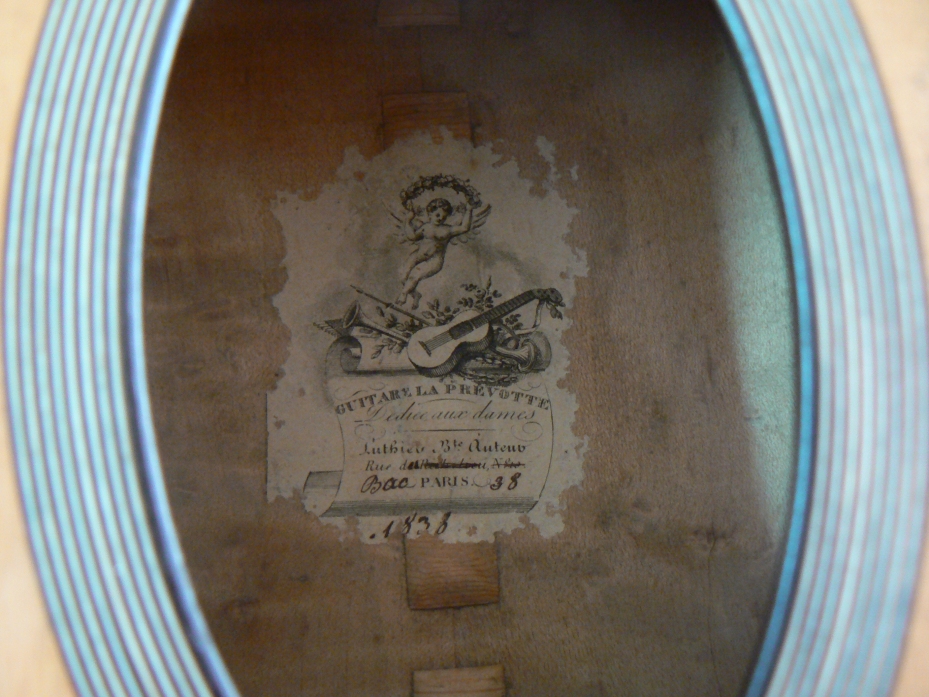
A reader asked me for some details about the bracing of the 1838 Laprevotte that I had in the shop some time ago.  Here is the information I was able to offer.  Remember that Laprevotte was a violin maker before he turned to guitars and another thing I like to keep in mind is that there are makers using this kind of bracing today who claim that they invented it, ha ha.


All measurements in mm.

There are four parallel longitudinal bars which I will number starting from the extreme treble side.  Number two is 38.5 from the centre line and number one is 37.5 from number two.  Number 3 is 42 from the centre line and number 4 is 35 from number 3. There are also four short cross bars between the two centre bars whose positions I measured from the 12th fret position.  Number 1 is at 60, number 2 is at 96, number 3 is at 280 and number 4 is at 388.

Back to the longitudinal bars, they are scalloped at the ends and are peaked gradually as opposed to being rectangular and simply rounded on the top.  The heights are Bar 1 ub (upperbout end) 7 and lb (lowerbout end) 8, Bar 2 ub 11.5 and lb 14,3, Bar 3 ub 12 and lb 14.3, Bar 4 ub 7.5 and lb 7.55.

The widths are Bar 1 3.5, Bar 2 increases from 3.5 ub to 4.5 lb, Bar 3 is 5.5, Bar 4 is 4.5.  Both Bars 2 and 3 seem to tuck under the neckblock and the endblock whereas Bars 1 and 4 either end at the linings or are also let in to the linings.  Here are the heights of the bars where they “end” after scalloping.

B1 ub 3.75 lb 3
B2 ub 4.2 lb 5
B3 ub 4.2 lb 5.35
B4 ub 3.8 lb 6

The length of the scallops:  Bars 2 and 3 are scalloped from the position of the nearest cross bar to each end.
B1 ub 42 lb 28.4
B4 ub 41 lb 49

The short cross bars are 7.5 high and 3.5 wide except for the one in between bridge and soundhole which is 4 wide.

Fleta 1953

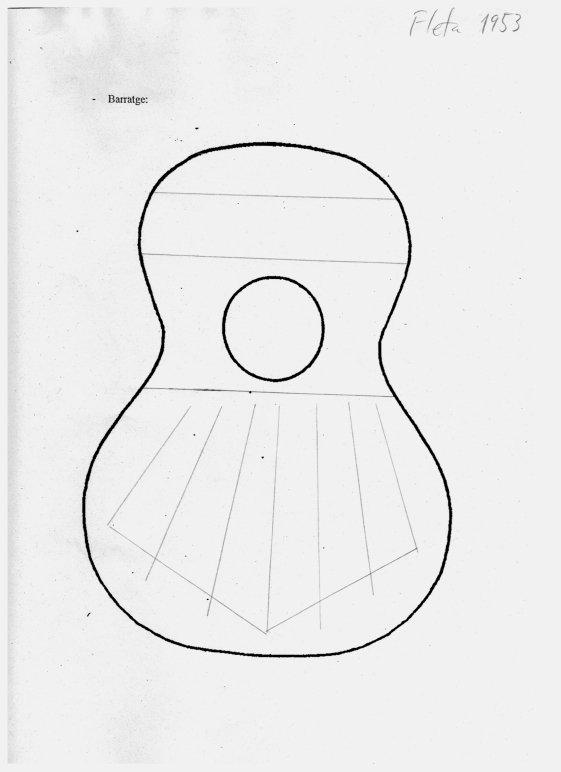
This was the first Fleta I had ever seen and I had some pleasant surprises.  I know that many players and makers just love his guitars but my experience was limited to the Courtnall plan and was far from positive.  My first guitar was made using a Hauser plan and guidance from a violin maker and although it is no great shakes it is the guitar I still use today to bang around on.  I then made a few guitars using the Fleta plan with nine fans, thick top and the extra diagonal bar.  I tried cedar and spruce but I never got a result I was happy with. 

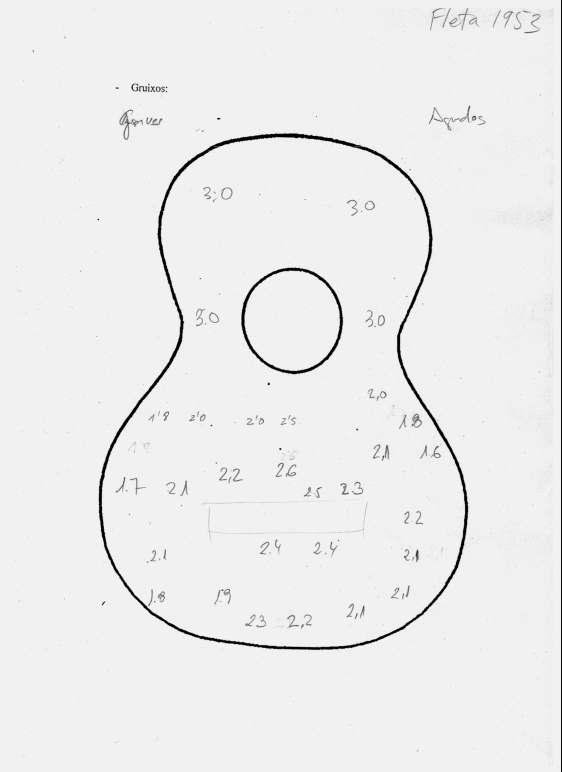
For a long time now whenever someone mentions Fleta I always thought of that plan so I was happy to be proven wrong at the Barcelona Museum of Music when I visited earlier this year.  Firstly I was very impressed by the sound of this guitar, and secondly the bracing and the thicknesses were completely different from that plan I mentioned.  Not surprising really, we see all sorts of variation and experiments among the better makers.  One thing I found very interesting is the very thick upper bout compared to the lower bout.  This is something that my teacher Rolf Eichinger did on his guitars but he had never credited anyone with the idea, perhaps he thought of it on his own and came to the same conclusions as Mr. Fleta.  I doubt it though, given the huge number of historical instruments that had passed through his hands.   I am sure that he saw this if it is indeed common to find in Fleta’s guitars. 


The right side (labelled agudos) is the treble side not that it matters in this case.

Up close with the 1900 Arias

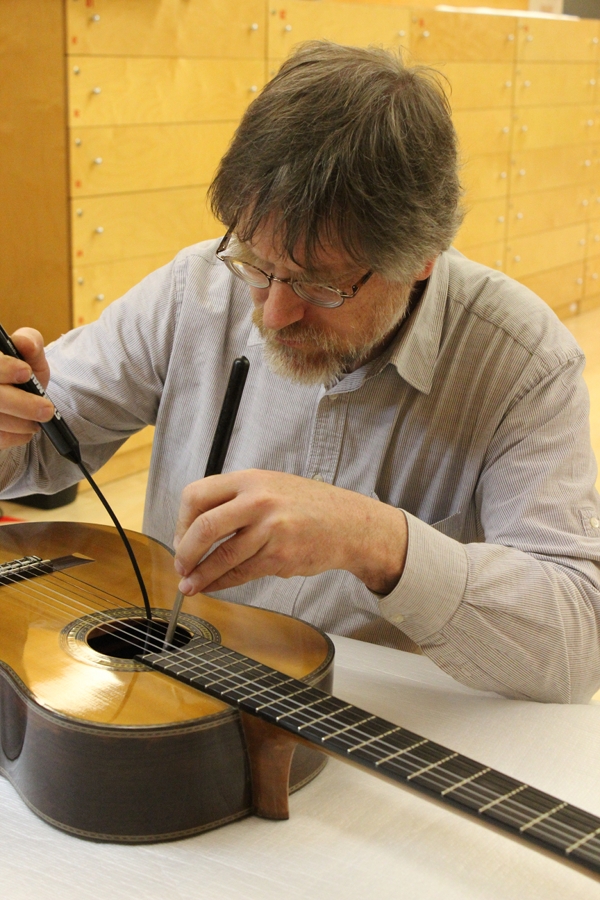
This is some information from my examination of the 1900 Vicente Arias.  The photos of this guitar can be found here and here.  Other articles have details of the building of the first replica.  The guitar has a label which tells us that Vicente Arias made it in 1900 shortly after moving to Madrid.  It is a relatively simple guitar with good quality wood and excellent craftsmanship but without the obsession with perfection that seems so desirable these days.  There is a double back probably 1 to 1.5mm thick with very light bars across it.  According to those who have studied other guitars of his he did this to get the sound of a very shallow instrument while giving the physical sensation of playing a full-sized instrument.  This explanation doesn’t fit with the two sound-port sized holes in the inside back just below the bridge. Since the outer back has been taken off it is very possible that these holes were made by someone else.  It should be noted that the back was taken off and replaced by an amateur or someone with no regard for the original work.  The back curve was ruined and no attempt was made to replace the filleting which was destroyed in the cutting. The headstock has also suffered some modification as can be seen in the photos and I think the original holes were plugged and redrilled at some point.  The added pieces of cedar on the head might make one think that this head once had tuning machines but I can find no evidence of that.  The top is extremely flexible, more so than anything I have ever seen.  However, the deformation in front of and behind the bridge is within acceptable limits (the curve in front remains positive) and there are no cracks on the top except for the typical ones along the fretboard.  There are three cracks on the outside back, one under the central reinforcement and the other two very likely cleated (perhaps the reason for the back removal?) as they show no movement when stressed.  There are some marks of slight burning on the underside of the top perhaps where the top was reheated after glueing the bridge on.  The peones are glued with no spaces in between them.

The following are some measurements in mm:

Depth: endblock   93
neck  92
upperbout 91
waist 82
lower bout 92
These would originally have been different but hard to tell by how much after the back removal.

bridge  25 wide and 28.5 with the lip
tie block is 8mm high off the soundboard and the front of the bridge is 6 high
wings are 3 high

soundhole diameter is 86
rosette width is 24.5

three bars on the top
the closest one to the neck is 3 high X6
next one is 15.5 X 6
last one “below the soundhole” is 14 X 6
not scallopped

the bars on the double back are 4 X 5.5

There are 7 fans 3 X 4.5 at the highest point, seemingly planed straight while sitting in the solera so are not uniform height.
they have a rounded profile.  The projection of these fans meet very approximately at the 10th fret.  I prefer to measure the separation of the fans at the third top bar and then again at the back edge of the bridge.  the first measurement is 30mm and the second is 45mm.  These round figures indicate that he used these measurements too as opposed to using a converging .  Please note on the pictures of the illuminated top the short finger braces, they are shaped just like the fans.

The space between the top and the inside back as measured at the “lower” edge of the soundhole is 79.

the length is 479, upper bout is 264, waist 228 and lower bout 365.

I finally got my hands on a Hacklinger gauge at the same time as I had the Arias in the workshop.  I checked it against my caliper on a few pieces of wood and found it was reading 1.6 for 1.7 so I would add 0.1 to the following measurements.   At first blush it seems that Mr. Arias settled on 1.6 mm as an appropriate thickness for top, back, double back and sides.  The sides in places go down to 1.4 but then anyone who has ever worked with Brazillian can understand that.  The back is very close to the double back so I was unable to get the Hacklinger to measure anything but the stretch between the second and third bars on the back and only that thanks to the “soundholes” in the double back.  The back showed 1.6 and 1.5 in the central area and 1.3 out towards the sides with lots of variation in the thickness which makes it hard to say with any certainty that this was his intention.  Who knows what was done to this back when it was removed.  The top shows one very thin area (1.2) where a tap plate was present and you can even feel a depression in that area, I think it is obvious that someone ripped it off, damaged the top and sanded it down and then someone covered it up with another tap plate. There is also a thick area behind the bridge thickest(2.0) near the end block behind the A string.  This area thins out gradually in all directions to the 1.6 thickness of the top within a distance of 4 or 5 centimetres.  I have no explanation for this although it does make for a thicker are in general behind the bridge.  One might think that the rest of the top was sanded down later in the guitar’s life and this part left thick but there are no signs of that, no sharp rising or increased thickness around the bridge and fretboard.  The rest of the top shows 1.4 to 1.6 very consistently, a bit heavier on the 1.6 readings (and even two 1.7 readings) between bridge and soundhole.  As you approach the edges of the guitar there is no decrease in thickness, actually in the lower bout there is even a tendency of maximum readings around the edges whereas as you move inwards you start to get about 0.1mm less. The top is extremely flexible and I get a resonance at just below F#.  I couldn’t get a very accurate measurement of the thickness of the double back but by making a saw cut in a small block of wood that just allowed the “soundport” edge to enter convinced me that thickness is 1.6 as well.  The holes in the double back are symmetrical and 32 mm in diameter with a separation of their centres of 96mm.  The double back has these tiny braces and then seems to have a second set on the “bottom” side as well, I can only just touch one with a finger.  The back brace (at least number 2) is about 15mm closer to the soundhole than the one we see on the double back.  The braces on the double back are scalloped but I think the ones on the back are not because I couldn’t get the magnet from the Hacklinger to pass through anywhere. As I think I mentioned before, whoever took the back off destroyed the back curve so assuming that the double back curve is still there then the distance between the two backs was originally greater than it is now (10.5 mm at the holes)  At one point I got a vibration by tapping on the back and was very worried about a crack until I realized that the bars of one of the backs is almost touching the other one and vibrated sometimes.  I can with very little pressure make them touch.  That gives us a pretty good idea how high the back bars are.  One of the things I try to do when I study an important instrument is get an idea of what the original archings were.  Usually an arch will flatten out under tension after 100 years but the edges of the top (or back) will still have their original angle upwards with respect to the plane of the top.  If you place a straight edge along the tangent at the edge you can read the distance the straight edge projects above the opposite edge. This allows us to reproduce a curve for the solera which should allow for the same reading on the finished copy.  The idea is that the arch will be the same as the original was in its beginings.  I placed my straight edge at the end block just off-centre so as to be able to take a reading at the top edge-23mm. Then at the fretboard and read at the endblock-7mm.  Transverse readings just in front of the bridge-13.5mm and on the brace below the soundhole-6mm and mid soundhole-7.5mm.  The back had no angles so I have to assume that the edges of the sides and linings were altered when the back was glued on again.  Of course it is possible that the original back had no arching at the edges but I sincerely doubt it.

Manuel Bellido 1974 and Antonio Marin 1966

The Ferrer family in Granada was an extremely important force in making Granada what it is today but the more I learn about that time the more I see that even with Eduardo Ferrer’s influence Granada might have gone in a very different direction.  What really changed everything was the influence of two young friends, both cabinet makers, one who began working for Eduardo Ferrer and the other who was a family friend of the Ferrers.  Antonio Marin Montero and Manuel López Bellido set up shop together and started on the road to forming the two most important guitar making dynasties in Granada.  Depending on whom you speak to the story is slightly different but without a doubt there was teaching and learning on both sides.  Antonio was the more experienced cabinet maker while Manuel had more experience making guitars.   But what made this venture so much more important than Casa Ferrer?  It might have everything to do with the difference between being a guitar seller who makes guitars (Ferrer) and a dedicated maker (Marin or Bellido) but that reflects my own opinions on this subject which you might not share.  A large number of the guitar makers at the time were trained or later worked in this large workshop.  Some started here and then went to work for Ferrer and others started with Ferrer and then came to the Bellido Montero shop.

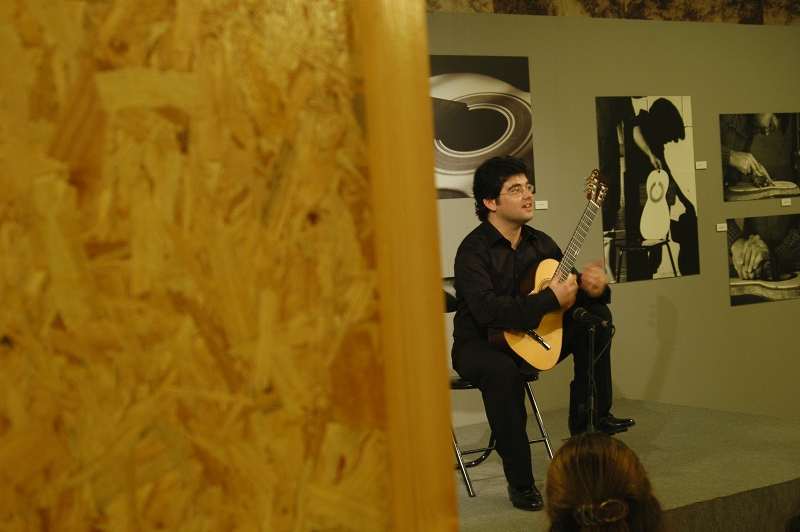
I was lucky enough to get two guitars in my shop last week which brought home the quality and passion of the work that these two men did, a Bellido from 1974 and a Marin from 1966.  Both guitars were braced with a light fan, one of them almost exactly Torres, including the unscalloped transverse bars and no bridge strap.  The other had Torres closing braces.  The top thicknesses were in the 1.9-2.0 mm range, the bodies were small and the total string length was 655 in both cases.  Here is a photo of Evaristo Valentí playing the Marin.  I won’t offer any more details about these guitars because the author of the upcoming book about the Granada makers wants to use them to illustrate the evolution of the Granada school.