The Torres rosette

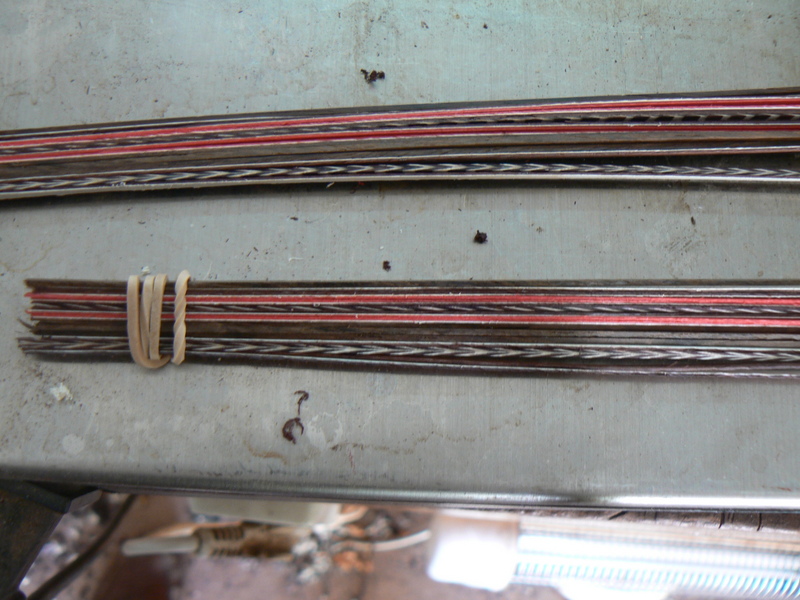
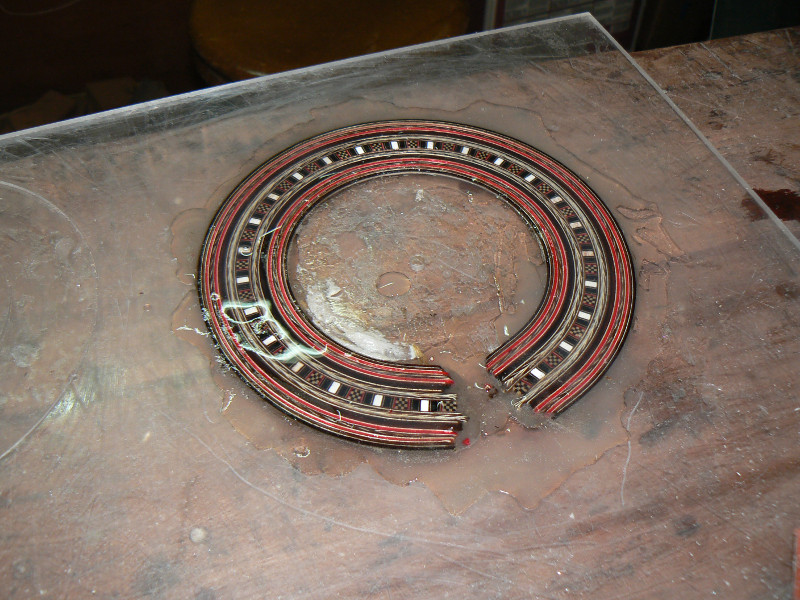
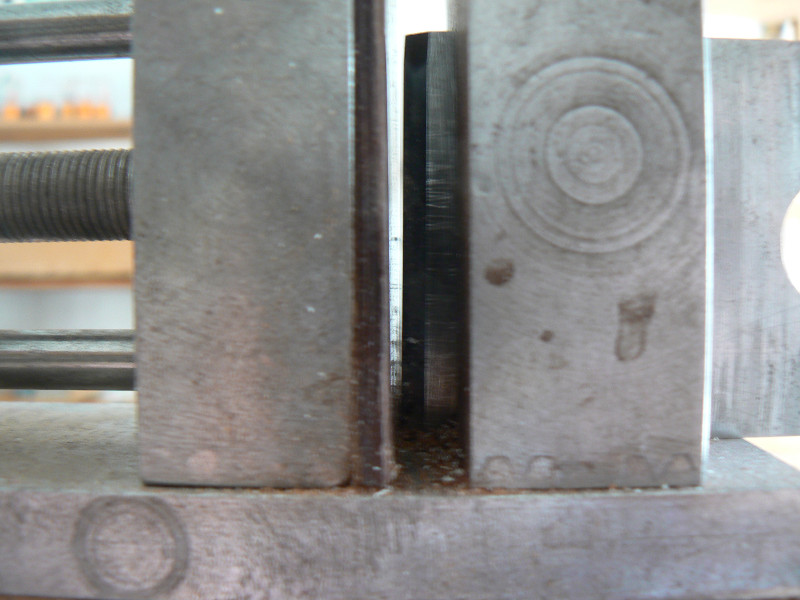
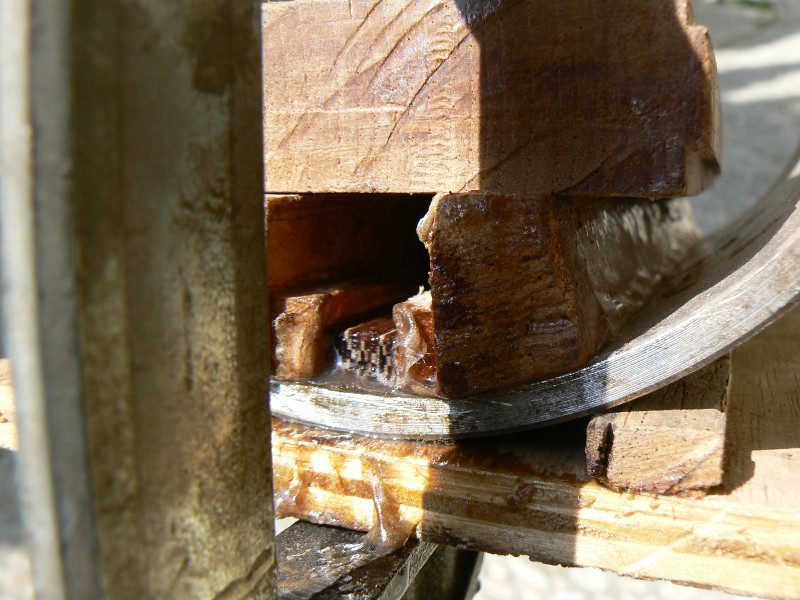
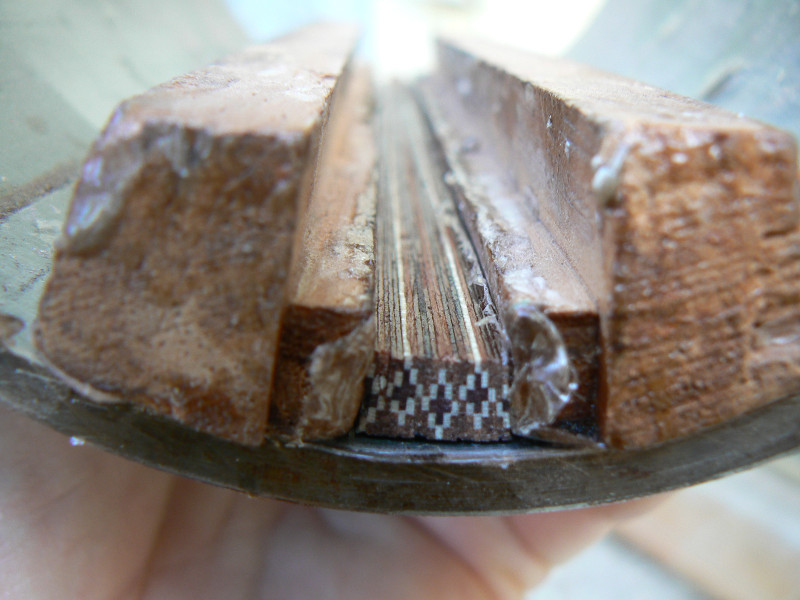
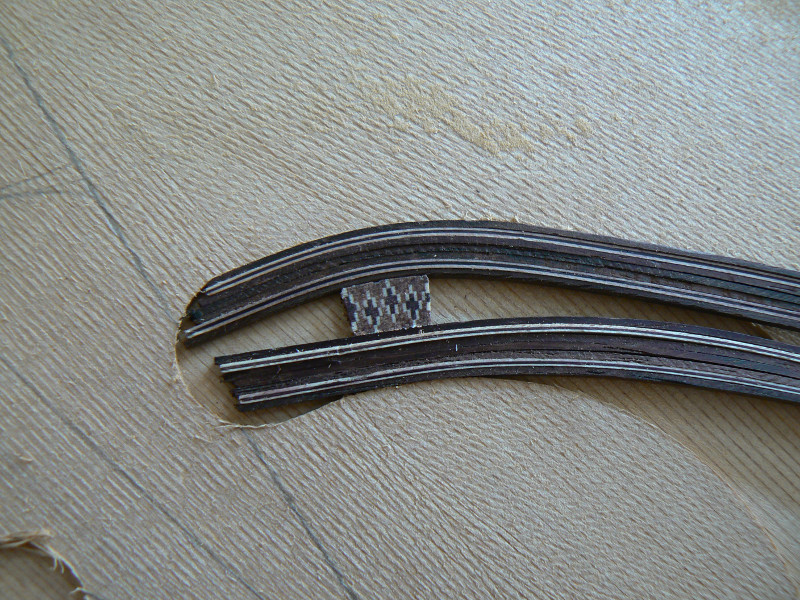
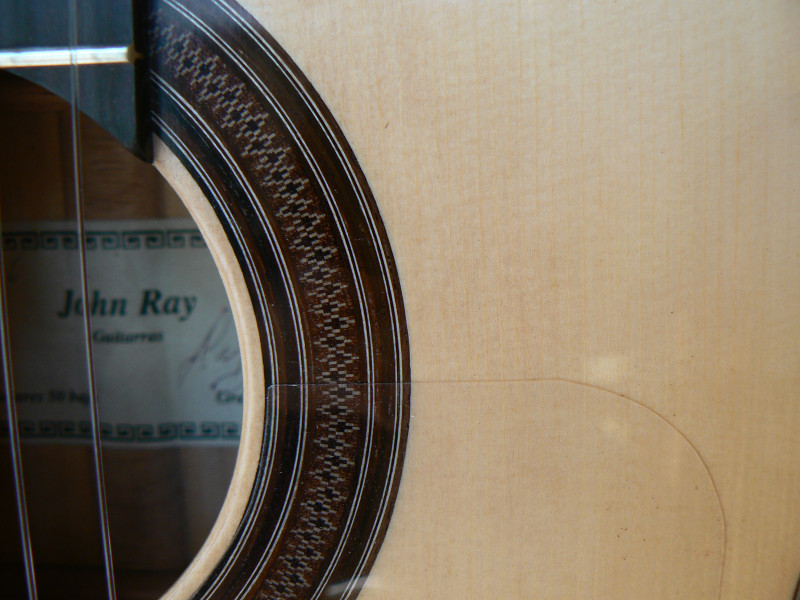
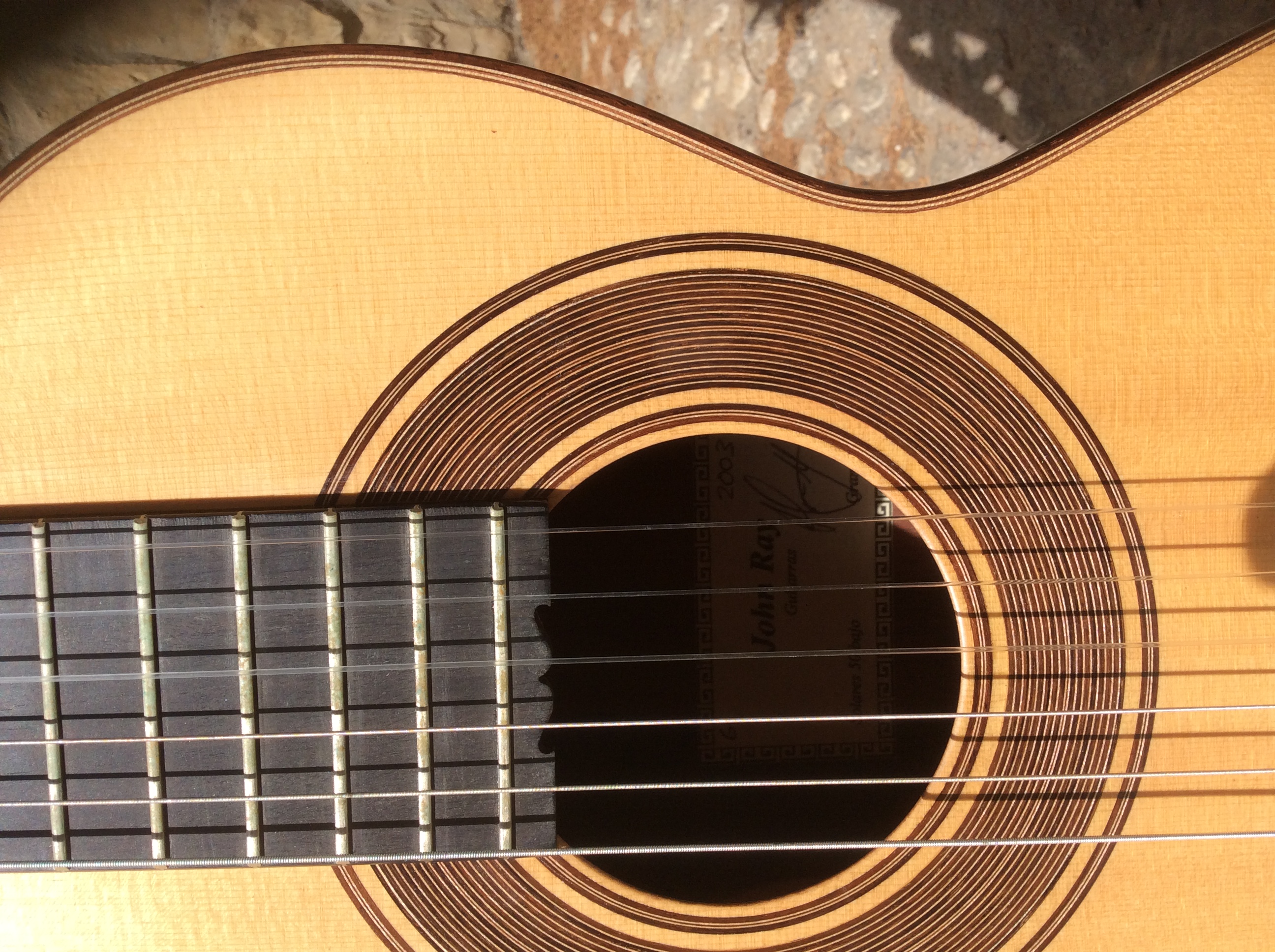
As you saw in the last post I can inlay the mosaic pieces along with the veneer lines into the channel in the top in one step.  However, the rosette on the Torres guitar I copy has a lot more lines, mother-of-pearl and some herringbone which needs to be placed so the “arrows” meet on the centre line of the top.  Years ago when I was having trouble with a wide rosette Rafael Moreno told me about the technique of glueing the rosette into a different piece of wood and then cutting it out and inlaying into the top.  From there to using plexiglass was a short step.  The problems I was having at the time were due to the swelling of the rosette with the glue and the more lines there are the bigger the problem.  P1020607 So I take the herringbone out of the set of veneer strips that you see above and replace it with plastic spacers which don’t stick to the wood and glue the whole rosette into the plexiglass just as if it were the top.  Glueing in the herringbone is then a simple task once the glue is dry and I can put it exactly where I want it.  Once again I think that Torres (and other builders) must have done something similar because otherwise how can you get the two herringbone points to meet exactly at one of the mother-of-pearl rectangles?P1030820

Rosette-making

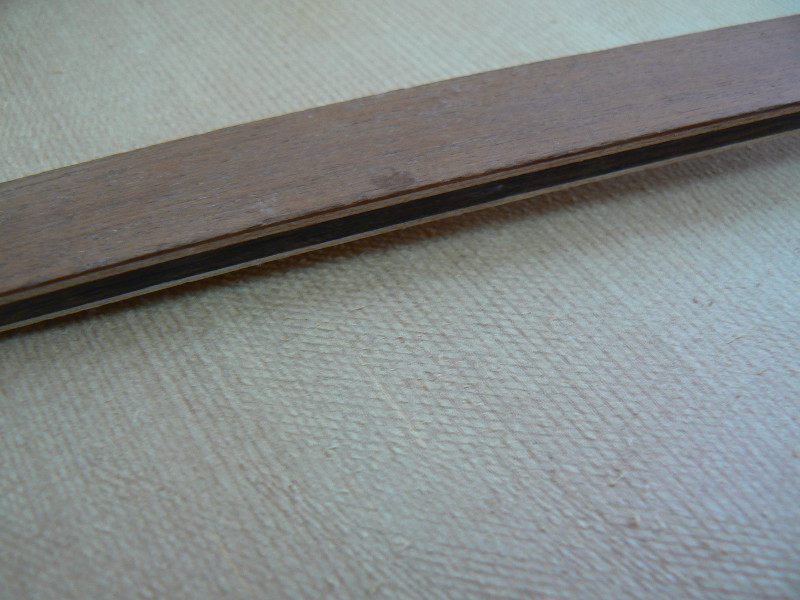
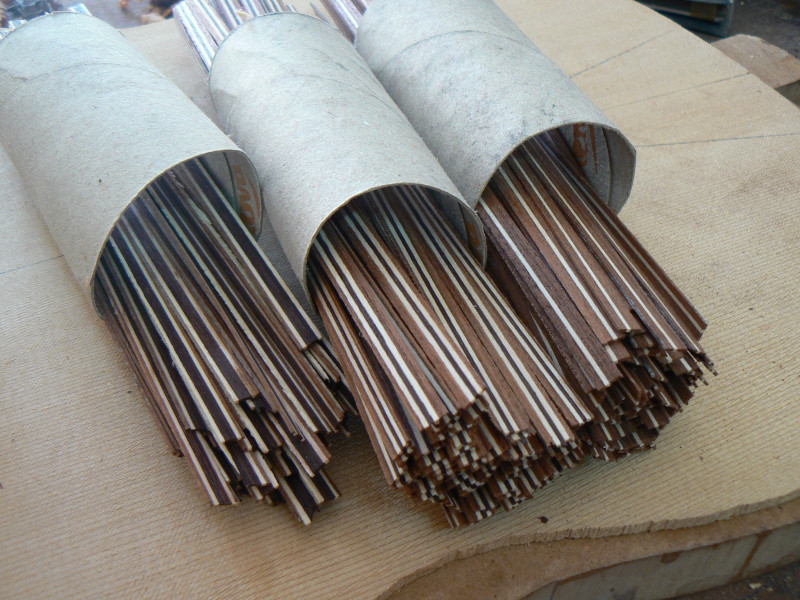
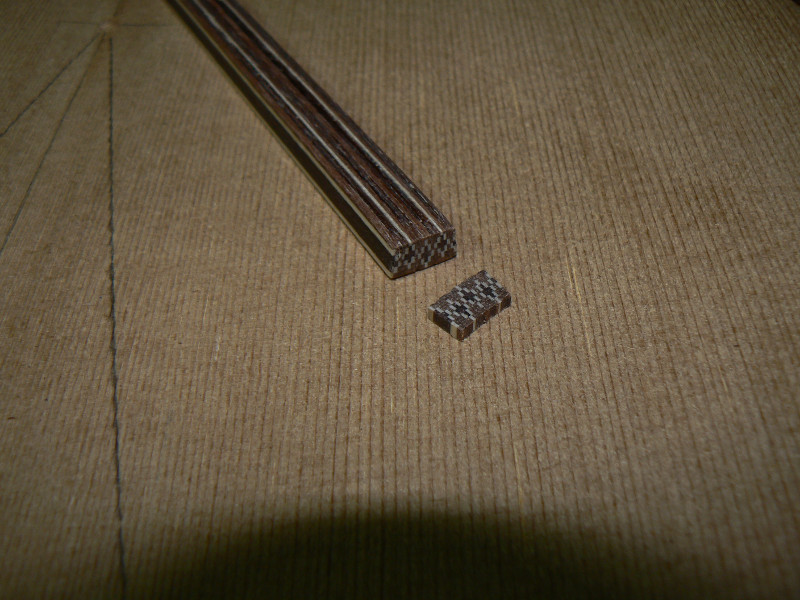
P1030795This is not a tutorial but rather a few photos for those of you who like to see how things are made.  Above you can see a number of .5 mm veneers of 3 different species of wood glued up.  For the rosette I am using now I have to make three different sandwiches.  Strips, which will be thinned to about 0.5 mm, are cut off of each one.  P1030793 I then give each strip the very slight wedge shape that you can see by looking ot the thicknesser in the photo below.  Usually this tool is used to thin purfling strips by pulling them through using a different blade.  P1030789 The next step is to glue the strips together in a round mold which ensures that each section (tile) will butt up against the next and conform to the inner and outer circumference.P1030799  I took another photo after I took the clamps off and cleaned up the end grain so that you can see everything more clearly.  Making rosettes is a lot of work but it is quite a simple way of doing it.  P1030801Now each slice is cut off and you can place them end to end to make a full circle with the diameter of the centre of your rosette.  The first time you do this there is some trial and error or geometric calculations to do.  P1030804Working this way you can inlay the strips and the tiles all at once.  You want a reasonably tight fit so you have to put the veneer strips in first and then force the tile in between so that the strips are pressed against the walls of the channel.P1030808  The last photo is the finished project taken from a flamenco guitar which is now at Casa Luthier in Barcelona.  I have made a few other rosettes but have been using this one for many years. P1030689 I don’t play around with new rosettes the way some makers do because I get enough variety with my historic reproductions.

Antonio de Lorca

Antonio de Torres

Vicente Arias


Manuel Ramirez 1911

I was recently asked to restore a Manuel Ramirez from 1911 that had once belonged to Francisco Calleja.  This guitar has a long and lively history of concerts and accidents, restorations and modifications.  Here you can find more information, in Spanish, about this guitar.  Some time between 1955 and 1966 the Banchetti brothers modified the guitars from a 7-string to a 6-string and there were extensive repairs made later by Hilario Barrera between 1966 and 1968.

P1030721

My first task was to decide with the owner Carlos Blanco if we should undertake a complete restoration (and surely change the sound) or rather limit ourselves to what was necessary for the conservation and playability of the guitar.  Often what is so appreciated in older instruments is the sound that comes with age, so we decided that we didn’t want to change that.  There is something to be said for architectural renewal of an instrument and giving it new acoustic life but the sound does change often for the better but it does change..  One reason that we decided not to do that is that it had already been done in one of the repairs that it had undergone and the result was not what I am sure they had hoped for.  Most of the bracing on the top was “new” and this new bracing had failed to support the doming fo the top.  P1030636

guides

GUIDES

Although I had to change the machine heads, file the fret ends and stop the bridge from coming up the most critical part of this job was to repair a new crack in the soundboard and to immobilize some old loose bits.P1030631  One thing that happens often with old guitars is that the top next to the  purfling or the rosette will pull up and vibrate.  On this guitar there were loose parts of the top in the lower bout and near the rosette.  This sort of problem is difficult because you can’t just put a cleat on, there is usually some sort of re-inforcement too close by.  In the second case I put the re-inforcement on the bar under the rosette so as to mitigate the added mass.  As for the crack that needed fixing I wanted to use as little mass as possible and to centre the cleats on the crack as closely as possible.  Pyramid-shaped cleats are easy to make if you take the back off and can work un-encumbered to give them that shape after you glue them on.   In order to achieve the same effect I prepared them all at the same time and then cut them all the way through. making diamonds Of course then I needed a caul to glue them on with.  At the same time I wanted to make sure that the grain was correctly oriented so I made something that would be easy to control as I worked blind.  P1030736What I used to centre the cleats was a combination of two methods, one being the thread which I pulled up through the crack and the other being two temporary guides which I placed inside the guitar. P1030728 This is common in restoration, you spend a lot of time preparing so that everything goes smoothly but then when you start working it goes more quickly.  Speed is important as we are obliged to use hot hide glue on instruments which were built with it in the first place.  It is also relevant that vestiges of this glue will not impede future restorations.  IMG_20140210_095551_0This means that if in the future someone thinks that my restoration criteria were flawed they can take off what I added and start again.  Here you can see the three cleats that I used for the crack.  You can also see some of the previous work.  I thought we should have a recording of this guitar just to see what the sound is like after so many years.