The Legacy of Antonio de Lorca

The following is translated from the pertinent sections of “La Guitarra Malagueña-Cinco Siglos de Historia” by E. Rioja 1989.  This information is probably found in one of his books but in this case the source is the catalogue of an exhibition of the same name.  Musicologist Eusebio Rioja wrote the only book about the guitar makers of Granada back in 1976 and has established himself as an expert on the Spanish guitar especially with regards to the makers of Andalucia.

Antonio de Lorca Garcia

Antonio was born to Asensio (a carpenter) and Florencia in the Spanish city of Cartagena in 1798 and baptised in the parish church of Santa Maria.  At the age of 20 he moved to Malaga where he was registered as living at number 13 Carretería street.  He married Francisca Pino, became a widower early on but not before having five children:  Dolores, Pilar, Encarnación, Antonio and Carolina.  He died in 1870.

His reputation as a guitar maker must have been good and he seemed to have no economic problems.  There are records of servants working at his home and a long list of journeymen in his workshop.  Among them were:  José María Torrens, José Salido, Antonio Pomar, and Salvador Castellón.  In 1848 he was awarded a silver medal by the “Sociedad Económica de Amigos del País in an exhibition on the presentation of “a guitar with excellent voices”.    This maker begins a dynasty which carries on with his son Antonio de Lorca Pino, his grandson Antonio de Lorca Ramirez and through Francisco Dominguez (guitar maker in the workshop of Lorca Pino) and his son José Dominguez still working today in Muro de San Julian street.  (José Dominguez died in the 90’s and left no disciples)

Domingo Prat, and some of the labels on Lorca’s guitars, claim that the workshop was founded in 1803 but given his birthdate of 1798 that seems highly unlikely.  In any case the relevance of this line of guitar makers is unquestionable, given the information above as well as the mention of Lorca in the following publications:

Francisco Bejarano, “Guitarrerías”

Sebastian Souvirón, “Historias del siglo XIX”

Manuel Blasco, “La Málaga de comienzos del siglo”


Antonio de Lorca Pino

This maker learned from his father and supervised Francisco Muñiz, Vicente Salido, Francisco Molina, the already mentioned Francisco Dominguez and of course his own son Antonio de Lorca Ramirez.   Domingo Prat writes of Lorca Pino the following:

“Lorca Pino, within the world of guitars, guitar makers, and guitarists he moved in, knew how to make his workshop a meeting point and place of study and critique where Torres, (Julian) Arcas, and (Juan) Parga and many others often visited.  We could say that among instruments and music the shavings fell down giving rise to multicoloured preludes.  Lorca Pino was a distinguished player, a student of Parga who in 1893 dedicated to Lorca his Opus 10 Capricho sobre las murcianas, his first concert rhapsody.   Juan Parga’s guitar that appears on the cover of his published works was built by Lorca, his guitarist disciple in 1889.”
Antonio de Lorca Ramirez

He continued the family tradition but increased production and included lower quality instruments in his offering.

A cd with one track on an original Lorca

A cd with duets on a Lorca copy

 

Antonio de Torres 1892 SE153

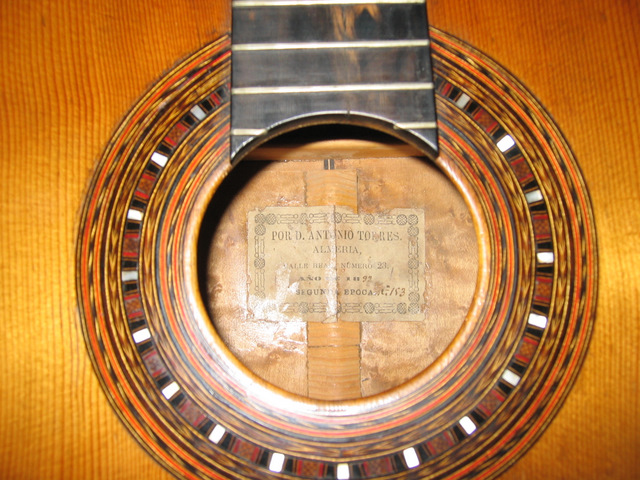
The original is from 1892 and is number SE 153 as you can see from the label.  I saw the original for the first time at a concert and workshop given by the owner Carles Trepat here in Spain.  We talked and I looked at and listened carefully to the guitar privately.  The idea to make a replica matured over the next year and we arranged to meet to take measurements and photos.  In the end I had to travel from Granada to Lerida (near Barcelona) to meet with Carles because although he had been in this area he was busy with concerts and masterclasses.  I convinced my master Rolf Eichinger to make the trip with me because I felt I needed his vast knowledge of historical instruments and how to read backwards from what you see on a 100 plus year old guitar.  So many things can change like arching, neck angle and even thicknesses over time.  We spent almost an entire day with the instrument and I took careful notes and these and other pictures.  We reconstructed the original arching of the guitar taking into account the angle of the top where it meets the sides at different points and disregarding the actual arching present today.  We took thickness measurements and tried to account for the final sanding and tried to spot repairs and refinishing.  The typical situation of slightly thinner perimeter usually indicates the above and not a desire by the maker to leave that part thinner.  Rolf was always obsessed with the harmony and aesthetics of the body shapes of the great makers’ guitars and his extensive experience in reconstructing those curves with compas and rule allowed me to make an accurate mold which made for a symmetrical and blanced body form; original but without the typical variations which are usually present in historical instruments.


My intention with this guitar is to make a perfect copy and at the same time to get as close to the sound of the original as possible.  I think to do both is impossible because of the time that has passed since 1892.  In order to get closer to the sound of the original I work slightly thinner and try to use my oldest and lightest-weight wood.  I even try to use similar looking top wood.  My philosophy of the copy is that the aesthetics and measurements should be the same but when it comes to techniques and methods which are not evident in the guitar I don’t trust what the “experts” claim were the methods of Torres.  Rather I think that the closest we can come to his methods is to follow the tradition he helped establish and to use those techniques still alive today.


Anything I have modified has been to make the guitar a better tool for the musician.  Things like:  some of the frets were not perfectly placed and the bridge compensation was not right on the original, since my guitar is thought to be very comfortable I carve the neck to a similar shape on this model, I make a small lip on the back of the bridge as added insurance against the bridge lifting.  The weight of the original was 1225g and the weight of my first copy (maple) was 1232.  That was just chance but it was satisfying.  I don’t worry about a specific weight or body frequence the way some makers do but I do try to keep the guitar light.  This guitar has taught me so much, I find myself needing to invent methods to achieve certain effects (on the rosette for example) and then I realize that Torres MUST have done it the same way so I have invented nothing.

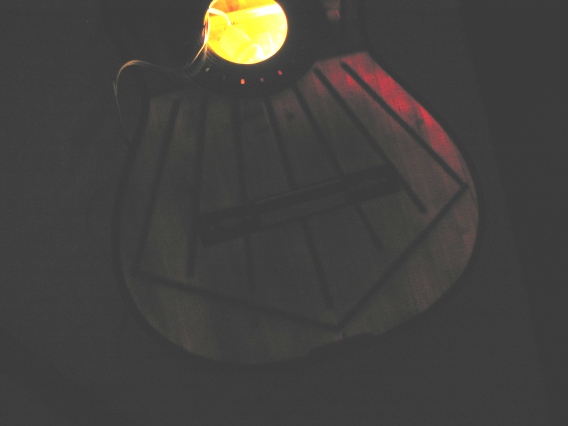
I am sure you are familiar with the technique of placing a light bulb inside the guitar to see the fan bracing.  However, with very old guitars the top is not nearly so translucent so I had to doctor this shot a bit to get the fans to show up clearly.  They were perfectly visible for the purpose of making my drawing but the original photo was not suitable for posting.


Here is a video of Trepat playing the original.

Innovation in 19th century Paris

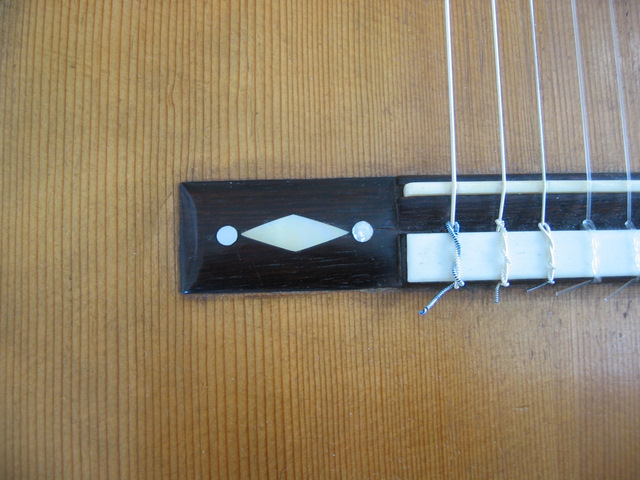
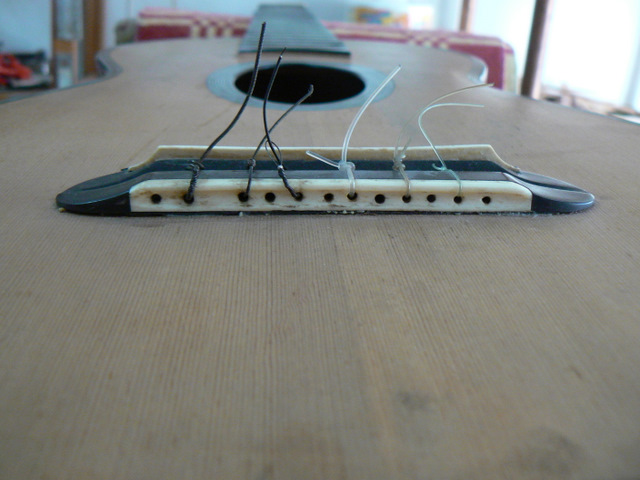
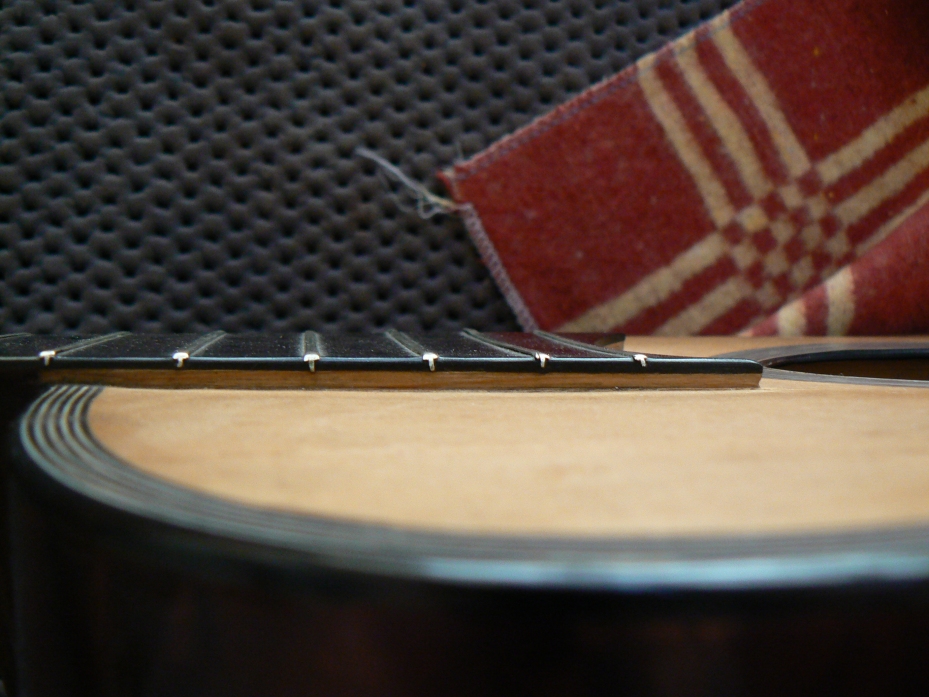
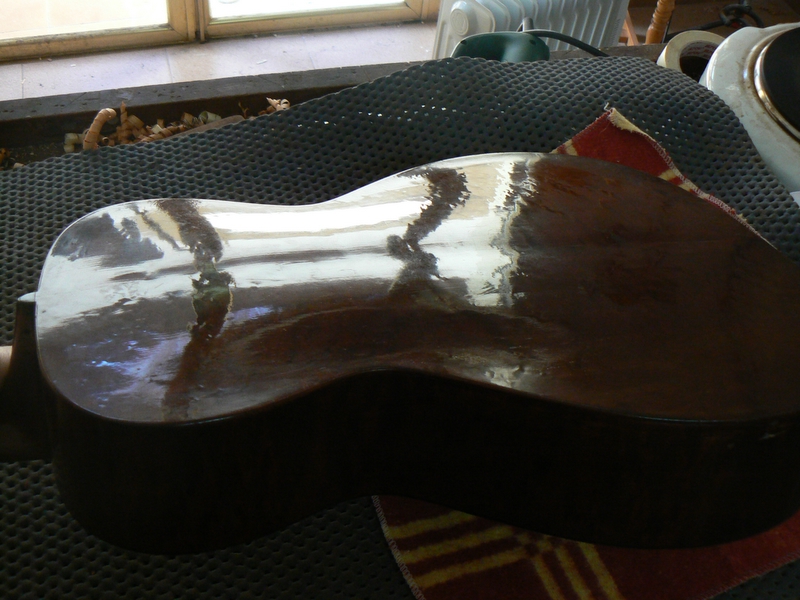
I mentioned in my last post (now corrected to read 1838) that the Laprévotte guitar had some modern features.  Here is a shot of the bridge showing the 12-holes; notice the placement of the second hole for the sixth string.  This surprised me and made me think that the twelve holes might be a later addition by someone else, however, I found photos of other Laprévottes with the same configuration.   I wouldn’t call this an elevated fingerboard but it could well have given later makers the idea to raise the fretboard.  As for the four violin-inspired bars, there is a maker here in Granada who claims to have developed an original system of bracing consisting of exclusively longitudinal bracing. Sorry, anything but original.  Carved backs on guitars is perhaps more a feature of antiques than it is of modern heavy back-light top combinations, the violin maker turned guitar maker was quite common back in Laprévotte’s time. 

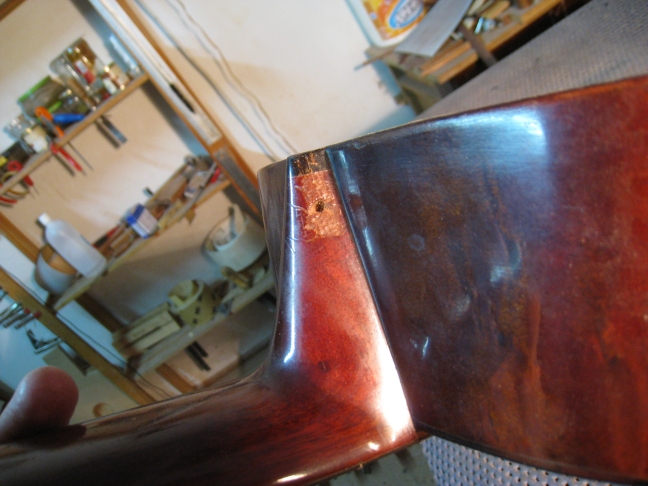
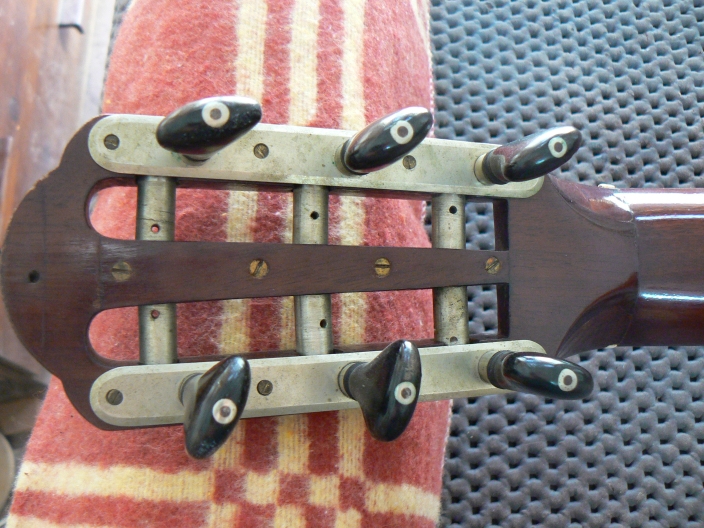
Some of you may be familiar with Aguado’s tripod, he called it the fixateur and guitars which were made or modified to use it had a hole in the endblock (often plugged by a button) and a hole in the side of the heel.  Aguado had at least one Laprévotte (the one in a museum in Madrid is purportedly his) and he is seen playing a very similar one on the cover of his method.Among those whom I contacted about this guitar there are those who suspect that this guitar might have belonged to Aguado.  Other great features of this guitar include the invisible neck to head joint and the hidden machine heads, both of which were (first?) used by Lacôte. 

Laprevotte 1838

It has been almost three years now since  this guitar came into my shop.  I had never heard of this maker but the quality of the construction, the aesthetics and the “modern” features intrigued me.  The owner was interested in having the guitar repaired as it had belonged to his father and he wanted to pass it on to his granddaughter.  There was a small crack next to the fingerboard and some deformation below the strings, otherwise the top was in good shape.  The bridge had been over-stressed by using metal strings and this had broken the front lip.  As is so common in these situations, someone had used white glue and had glued saddle and bridge all together in a big mess.  The carved back had sunken and had also shrunk to the point that the sides had a larger outline than the back and had opened up.  In the end the owner chose not to have the restoration done and I refused to do the simple repairs that he had originally intended.  As you will see this guitar is quite a treasure and the only option is to restore it properly or leave it as it is.


My first step was to contact Sinier de Ridder who are the foremost experts on French guitars and excellent restorers.  I learned that Etienne Laprévotte was a violin maker, a contemporary of Lacôte, who turned to guitar making.  The violin heritage is present in this guitar in the carved back, the neck dovetailed into the body and the special bracing of the top.  The bracing consists of four longitudinal bars like the bass bar of a violin.  The book by Sinier de Ridder on the French guitar (Volume 1) was extremely helpful and includes x-rays of the instruments including a Laprevotte. 

Next post will include more details of this guitar.

Choosing wood for a guitar

I just finished the guitars I was working on and so had to dig through my stash of wood to find something for the orders I have to fill now.  This got me thinking about wood in general, wood sellers and the way they grade wood, guitar buyers and what they expect and the different criteria that makers use for choosing wood.  The companies that sell us wood used to have two or three grades of wood with the best being A or first (logical).  Since then they have slowly added categories so we began to see AA and now we have AAA and of course lately “Master”  These categories are useful to the dealers and allow them to charge very high prices for what they consider to be the best wood but to us they are practically meaningless.  For all the best intentions the dealers might have, until they start making guitars and can see what specific physical characteristics are desirable they will always be working blind.  They grade the tops by sight only; they don’t have the time nor the sensitivity to judge each top with their other senses (in reality we don’t expect them to).  We understand too that most of them will not split the wood as we do when we get the opportunity because they get fewer saleable pieces from a tree when they split it.  Even in the case of a guitar maker who buys, then grades and sells wood we find that the buyer doesn’t always share the seller’s idea about what is the best quality wood.  Each maker looks for certain qualities in the wood because he knows what result he will get when he uses wood with those qualities.

So what does all this mean?  It means that if you don’t make guitars then you don’t know squat about guitar-making wood.  It means that if you as a maker want the best and most appropriate wood for guitar making you have to go to the dealer and pick through the master grade, the AAA and the AA (and maybe more).  Some think we do this to get the cheaper wood but actually we know that the best wood is not necessarily in the master stacks so we search through all we can.  In trying to be the best, most ethical makers we can, one of the problems we run up against is the excess of information (and misinformation) especially on the internet.  This idea of the “master grade” tonewood has reached the end user and now everyone expects a concert instrument to be made with “master grade” wood. “Are you telling me that I have to use the wood that the wood seller thinks is the best when I make a guitar for you?”  Wouldn’t it be better if I, after making 160 guitars, were to decide what is the best wood, store and season it for 10 or 15 years and then use it in the way that best takes advantage of its physical characteristics?   I am willing to allow the client some input on the wood I use for his/her guitar but the choices must be from among the sets that I have chosen when I bought the wood in the first place.

Another problem we come up against is the client’s concept of beautiful wood.  Very often a woodworker sees beauty in the stability, evenness of grain and other characteristics that make the wood easier to work with.  We learn to love the species which we can rely on not to crack or deform.  Usually the most stable cut of wood will not yield the most spectacular aesthetic.   For example, Brazillian Rosewood is prone to cracking and deformations but has a better chance of being stable if it has straight, even grain and especially if it is riftsawn.   Bird’s eye maple can make spectacular-looking guitars but can also make for deformed backs and sides.  This is because in order to bring out the best eyes, the wood is flatsawn.  Curly maple is sometimes flatsawn too and can cause the same problem.  A discussion came up recently on one of the forums about bearclaw spruce and it was reported that many years ago the wood sellers couldn’t sell it.  Of course they couldn’t!  If straight, even grain and no run-out are so important in a top then surely bearclaw (localized runout) is not going to be great.  I won’t say it is bad wood and I do buy some because I know that clients will ask for it and I realize that aesthetics are very important these days.  I think we all agree that the top wood is extremely important but what makes a great top?  Certainly not grains per inch.  My most successful guitar (more concerts and recordings than any other) has a top with 8 grains per inch.

In conclusion I would like to say something I have said publicly before: Trust your guitar maker!  When you are looking for a guitar, play as many guitars as you can by a maker, find out who the maker’s teacher was, how many guitars he/she has made and then leave all “acoustic” decisions up to the maker.  We are not going to limit ourselves to using Cypress and Indian Rosewood (wonderfully stable woods) but if I use a piece of wood on your guitar it is because I think it will work musically and physically with my way of building.  Here are a few samples of 14-year-old wood which I will use soon.  Some of it is very beautiful but I will feel much better about using the straight-grained pieces.  Usually if you keep it for 10 to 15 years before you use it you can see any deformations and cut it up for headplates or decorative strips if it is going to cause problems for back and sides.